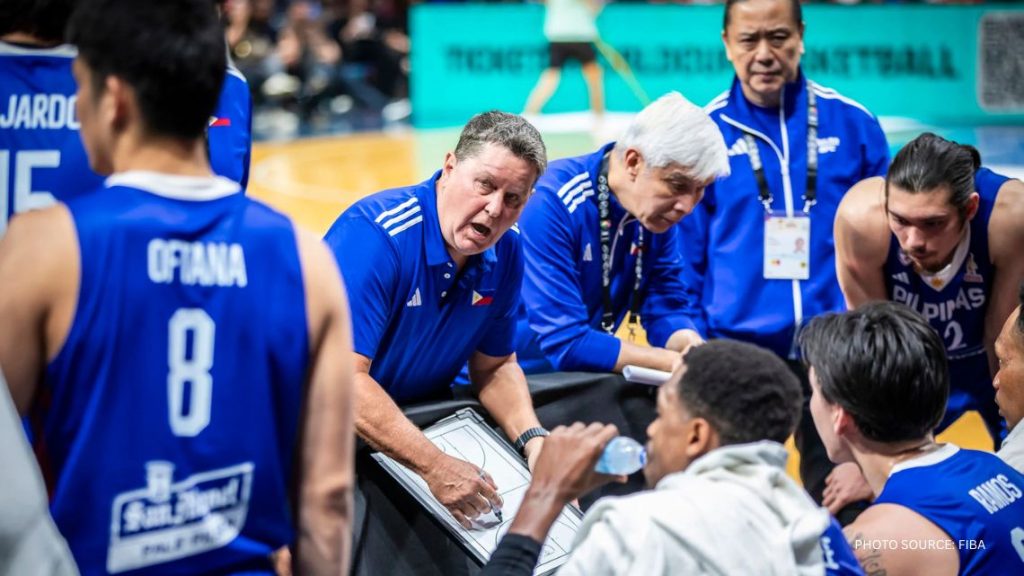
Cone: No Pride in Close Calls
On a night when the numbers told an ugly story, Tim Cone refused to hide behind them.
“I’m not going to sit here and pretend like I’m happy about our performance,” the legendary coach said after Gilas Pilipinas fell 69–66 to New Zealand in their FIBA World Cup Asian Qualifiers clash at Mall of Asia Arena.
“The bottom line is we’re not going to feel good or take pride that we got close or almost won or whatever. Bottom line is we’re here to win and we didn’t do that.”
The final margin was three points. The reality felt wider.
For three quarters, Gilas wrestled with the kind of offensive stagnation that doesn’t show up fully in a box score but suffocates a game all the same. The Philippines shot 33 percent (26/80) from the field and just 18.9 (7/37) percent from three. Justin Brownlee, the program’s stabilizer and late-game compass, was held to four points on 2-of-10 shooting without a free throw attempt. Dwight Ramos and CJ Perez combined for 31 on 35 shot attempts, but most baskets felt labored, contested, earned the hard way.
Cone bristled at the easy explanation.
“I hate saying we didn’t make shots because there’s more to the game than making shots,” he said. “That’s an easy explanation. If you’re saying that, usually it’s because you’re not getting good shots. We didn’t get the shots that we wanted, we didn’t get the flow that we wanted. Credit to [New Zealand] because they defended well as well.”
That last part matters. New Zealand didn’t just survive. The Tall Blacks dictated terms of physical engagement, despite their own shooting struggles from the field and charity stripe.
They pushed, they held, and they battled. They crowded Brownlee on catches, sent timely doubles, and disrupted the occasional triangle’s rhythm before it could breathe. The Philippines managed only 46 points through three quarters. By the time Gilas found urgency in the fourth, cutting into an 11-point deficit and giving themselves a final hurrah to force overtime, they were chasing a game that had already slipped into New Zealand’s preferred tempo.
Cone did find slivers of substance amid the frustration.
“There were certain parts of the game we did well, we defended well, we competed on the boards. Our big guys – [Quentin Millora-Brown] and AJ [Edu] played really well.”
But Cone’s refusal to accept moral victories says more about where the Philippine national team’s program believes it stands.
Since 2016, New Zealand has routed Gilas multiple times in FIBA play, including lopsided losses in the 2022 World Cup Qualifiers and the Asia Cup. A breakthrough win in the 2024 Asia Cup Qualifiers suggested the gap had narrowed. Since then, however, the Tall Blacks have reasserted control. This latest result marked another narrow but telling reminder that closing a gap is not the same as overtaking an opponent.
In Group A, the loss dropped the Philippines to 2–1, still in position to advance, but Australia looms. The margin for error shrinks.
That is the undercurrent beneath Cone’s words. Not anger. Not panic. Urgency.
“We’re not going to take any pride in almost winning or making the game close or whatever,” he said. “We showed up to win and we didn’t do that tonight.”
For a program that has spent the past few years recalibrating expectations, that stance feels deliberate. Close is no longer comforting. Competitive is no longer enough.
The Philippines didn’t get the flow it wanted. It didn’t get the shots it wanted. Most of all, it didn’t get the result it came for.
In FIBA qualifying, that is the only bottom line that matters.