The Trophy Built to Stand Tall
Before a champion can lift a trophy, someone has to decide what that piece of hardware is supposed to mean.
For the Asiabasket NSAC College Basketball Campus Tour, that question required more reflection than usual.
This was not just about producing a shiny object for the postgame ceremony. It was about giving a young tournament something people could remember, something players could chase, and something schools could eventually treat as part of their own history.
The result is hard to miss.
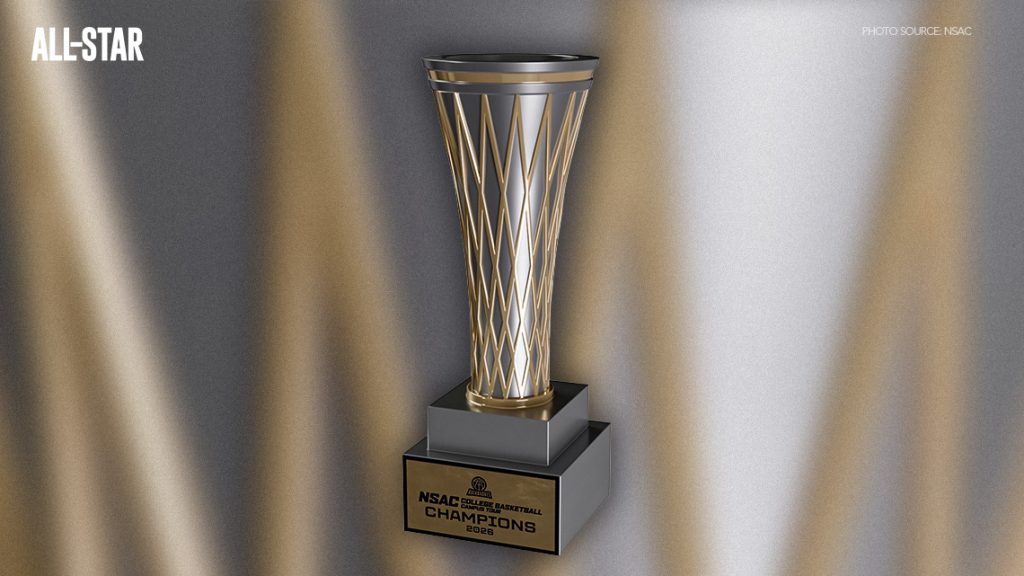
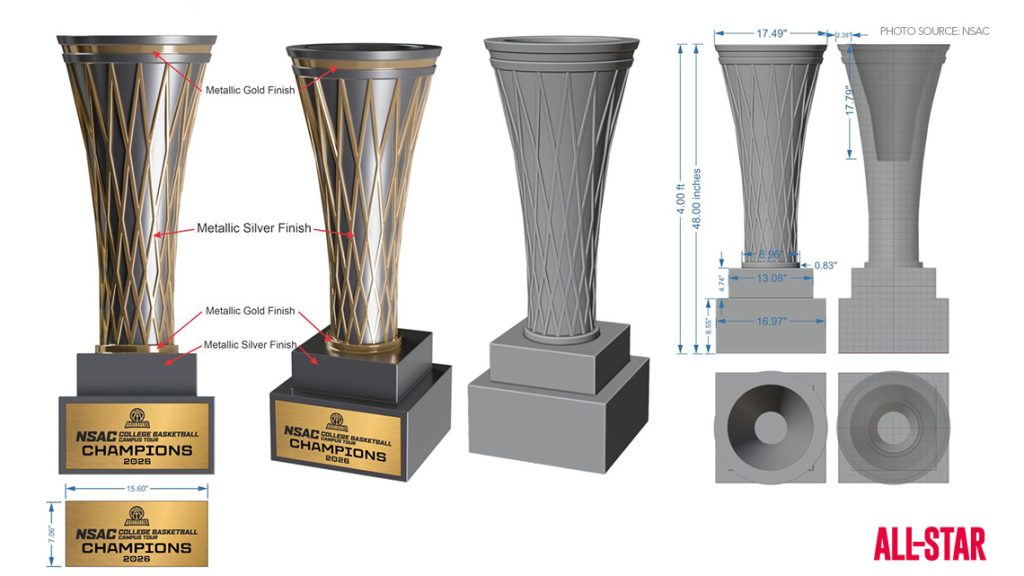
The NSAC championship trophy stands four feet tall, with a sleek silver body, gold accents, and long geometric lines that climb upward like a net stretched across a rim. It has the shape and presence of something made for basketball, but it also avoids being too literal. There is no excess, no clutter, no attempt to say everything at once. It is polished, modern, and direct.
For league owner Jai Reyes, that was exactly the point.
“We want it to represent excellence and unity,” Reyes said.
“That is the league we are trying to build.”
The word unity comes up often when Reyes talks about the NSAC. To him, the tournament is not only a competition among schools. It is also an attempt to bring more of the Philippine college basketball landscape into one shared space, where programs can test themselves, communities can gather, and schools can feel that the league is built with them, not just around them.
“We want to unify the college basketball landscape in the Philippines by creating a league that supports the teams and schools to keep improving,” he said in an exclusive interview with ALL-STAR Magazine.
“Our league is all about community.”
That belief is easy to connect to the format of the NSAC itself. The tournament has leaned into the energy of campus basketball, where games are not just events on a schedule but school gatherings. Every matchup carries the sound of drums, alumni chatter, student sections, rival colors, and the familiar feeling that college basketball is strongest when the community feels close to the court.
In that kind of setting, the trophy becomes the thing players picture when the games get tight, the item fans want to see inside their school’s trophy room, and the source of pride that can give a new league a visual identity.
That was also the challenge for James Cruz, Asiabasket’s Brand and Marketing Head, who led the design process.
“The first thing that we all agreed on was that the trophy should be iconic and impactful,” Cruz said. “We wanted it to be something that the schools would want to compete and play hard for, and further, something that they will proudly display in their trophy rooms.”
Cruz was given freedom by the Asiabasket team to shape the design, but the trophy still had to serve the bigger idea behind the league. It had to carry the values Reyes wanted attached to the NSAC: excellence, unity, and long-term ambition. From there, Cruz developed a working design, refined it through feedback from the team, and also took input from close friends in the sports industry.
The final look is built around basketball without being predictable. Cruz said the general silhouette resembles a basketball hoop, while the gold lines represent the net. That detail gives the trophy movement. The lines rise and cross around the silver body, almost like a championship path full of pressure points, intersections, and momentum shifts.
The trophy also sits on a double base, a design choice Cruz said has meaning that will be shared at another time. For now, it adds to the trophy’s sense of weight and permanence. This is not a small award meant to disappear in a corner. It is meant to hold space.
“It’s not an accident that it’s four feet tall,” Cruz said. “We wanted an iconic and impactful trophy. But also, we want a trophy that will stand tall alongside these lengthy basketball athletes.”
In college basketball, there is always a danger that the final symbol does not match the scale of the competition. Teams can fight through physical games, hostile crowds, long academic hours, and emotional finishes, only to end the season with an award that feels too small for what they endured.
Cruz did not want that for the NSAC.
“There have been instances in the past wherein the competition was so fierce but the trophy was underwhelming,” he said. “We definitely did not want that to be the case with the NSAC.”
The trophy looks built for a center-court celebration, but Reyes also sees it as something that should live beyond one night.
“We want the teams and community to remember the league with the trophy,” he said. “We want everyone to be proud of their involvement, and I think the trophy this year will achieve this.”
The league is still young, but its ambition is already clear. NSAC stands for National Student Athletes Championship, and Cruz said the word national is not just a label.
“We take the national component seriously,” he said. “That’s what’s at the heart of this tournament, a desire to crown a champion with a competition that involves the top schools in the entire country.”
There are limits to what any tournament can execute. Schedules, venues, broadcasts, school coordination, and fan engagement all take time to build. Cruz acknowledged that Asiabasket was working within those realities, but he also made it clear that the league sees this as a starting point, not the finished product.
“This being our first year, we were quite limited with what we were able to execute, but expect that to change in the near future,” he said.
The next step, according to both Reyes and Cruz, will come through listening. Asiabasket wants feedback from the people closest to the league: the schools, players, coaches, fans, and campus communities. The plan is not simply to make the NSAC bigger for the sake of size. It is to make it feel more owned by the people participating in it.
“We want to grow by listening to the school communities,” Reyes said. “We want them to own the league by making them feel important.”
The NSAC wants to build tradition.
It wants a championship that schools talk about. It wants a trophy that means more each year because of the teams that competed for it before.
“Hopefully this trophy becomes a yearly tradition important to their respective communities,” Reyes said.
Cruz sees the same long runway. Broadcast, social media, and the fan experience are all areas Asiabasket wants to develop, but he said the most important step will be gathering feedback after the first tournament.
“Armed with that, we’ll be able to come back with a bigger and better season two,” he said.
For now, the trophy gives the NSAC something tangible to rally around. It captures the league’s first big promise in metal, color, height, and shape. And soon, one team will lift it.
When that happens, the trophy will stop being just a design. It will have a champion attached to it, a school attached to it, and a memory attached to it. For a league trying to build community, that is where tradition begins.