
A Data-Driven Preview of the UAAP Season 89 Men’s Basketball Tournament
With the UAAP Season 89 Men’s Basketball Tournament tipping off on Sunday, September 13, the wait is almost over. But before the teams take the court, the preseason numbers offer an early glimpse of what could be in store.
The data spans four preseason tournaments: the AsiaBasket NSAC College Basketball Tour, this year’s Filoil EcoOil Preseason Cup, the NSAC World Invitational, and the Pinoyliga Cup – The Big Dance. Across these competitions, the numbers provide a snapshot of where each team stands heading into the new season—and perhaps a few clues about who could make a push when the games begin.
This analysis combines available team and player data from the four preseason tournaments above, with each game treated equally in building each school’s overall preseason sample. Team ratings and player averages were then calculated across those games.
Tournament participation varied across the seven teams included in the analysis. All seven participated in AsiaBasket, while all except Ateneo competed in the Filoil EcoOil Preseason Cup. FEU and UST were the only teams to participate in the NSAC World Invitational, while Ateneo, Adamson, and UST were the only teams to see action in the Pinoyliga Cup – The Big Dance. However, Adamson played just one game in the tournament, leaving Ateneo and UST with enough games to be accounted for in the analysis.
Note: UE is not included in this analysis, as the Red Warriors did not participate in any of the four tournaments.
Preseason Net Ratings
The chart below plots each team by offensive rating (points scored per 100 possessions) and defensive rating (points allowed per 100 possessions, with lower being better), dividing the field into four quadrants: elite two-way teams that excel on both ends, defensive anchors that make their mark by locking teams down, offensive engines that can put points on the board but give up plenty in return, and teams still a work in progress at both ends of the floor.
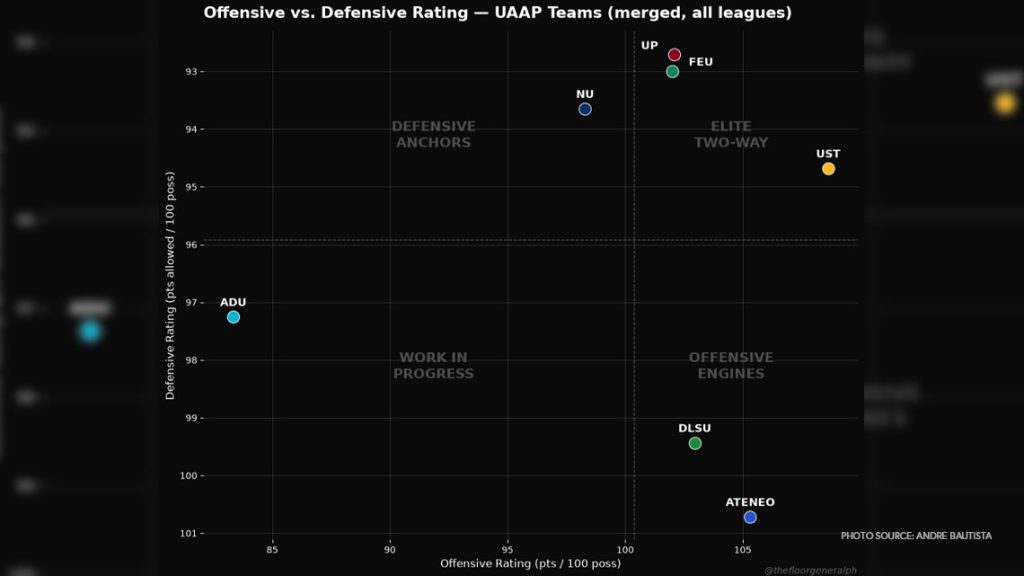
Net rating (offensive rating minus defensive rating) ranks as follows:
- UST — +14
- UP — +9.4
- FEU — +9
- Ateneo — +4.6
- NU — +4.6
- La Salle — +3.5
- Adamson — -13.9
To no one’s surprise, UST sits atop the preseason rankings. The Growling Tigers, along with UP and FEU, landed in the elite two-way quadrant—the only three teams that finished above average on both ends of the floor. UST backed that up by winning both the AsiaBasket NSAC College Basketball Tour and the Pinoyliga Cup – The Big Dance, while also coming close to winning the NSAC World Invitational. If it takes a Japan B1 League team to stop this UST squad, then the rest of the UAAP should have their hands full.
Behind them is UP, another team that showed why it could be one of the league’s most stacked teams. The Fighting Maroons may have fallen short in both AsiaBasket and FilOil, but they still ranked second in net rating and put together several impressive performances, including a 20-point win over La Salle. If this is what UP looks like in the preseason, expect them to be even more dangerous once the season begins.
Also landing in the same quadrant, FEU made a strong case as a team ready to take the next step. While their numbers may have been boosted by dominant wins over NCAA teams in AsiaBasket, the Tamaraws also beat UP and held their own against NU and La Salle. The results suggest FEU could be ready to make the jump from promising team to legitimate contender.
Ateneo, meanwhile, landed in the offensive engine quadrant, showing an offense that ranked above average despite giving some points back on the defensive end. The Blue Eagles had a limited preseason following the tragic incident this summer, playing only in AsiaBasket and Pinoyliga. Despite the smaller sample, they still made a positive impression heading into the UAAP.
Matching Ateneo’s net rating, NU quietly put together a strong preseason of its own—but in a very different way. The Bulldogs were the lone defensive anchor, with a defense strong enough to keep them in positive territory despite an offense that fell below the group average. They reached the AsiaBasket finals and picked up wins over UST, FEU, and Adamson in FilOil. Don’t sleep on NU—they could very well make a push for the Final Four.
For La Salle, the preseason numbers were less encouraging. The Green Archers also landed among the offensive engines, with an offense that ranked above average but a defense that gave up more points than the group average. Still, there’s plenty of firepower left despite the loss of Mike Phillips. La Salle may not have shown its best form yet, and perhaps they’re simply saving the good stuff for when it matters.
Lastly, there’s Adamson. The Soaring Falcons sit alone in the work in progress quadrant, the only team that finished below average on both ends of the floor. They had the roughest preseason among the seven teams, leaving plenty of questions heading into the UAAP. Now, it’s all about how they respond once the games start counting.
But the quadrants only tell us where each team landed—they don’t fully explain why. Let’s take it a step further and break down each team’s profile, using the numbers to uncover their strengths, weaknesses, and what could ultimately define their season. Each profile chart compares a team’s own numbers with what its opponents were able to do against it, giving us a closer look at how they arrived at their respective spots.
UST Growling Tigers
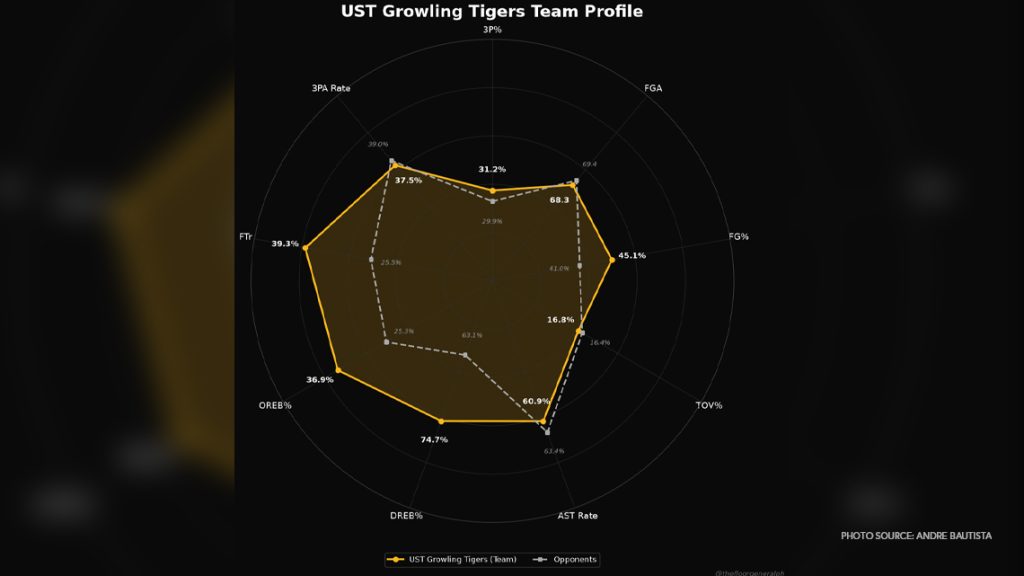
Just as the graph suggests, UST is a well-rounded team that checks all the boxes—shooting more efficiently than its opponents, outrebounding them on both ends of the floor, and getting to the free-throw line more often.
The driving force behind it all is none other than last season’s Rookie of the Year, Collins Akowe.
In terms of scoring, Akowe leads the España-based squad with 16.2 points per game across the four preseason tournaments, showing just how consistent he has been. It also helps that, alongside Akowe, the Growling Tigers have two new leaders to rely on in Mark Llemit and Amiel Acido, averaging 11.7 and 11.6 points per game, respectively. That becomes crucial following the departure of key players like Nic Cabañero, Forthsky Padrigao, and Kyle Paranada.
Akowe also leads the team in rebounding, pulling down 9 boards per game, including 3.5 on the offensive end. Koji Buenaflor, Llemit, Gelo Crisostomo, and Kris Porter have also done a great job on the glass, averaging 5, 4.9, 4.9, and 4.5 rebounds, respectively. With the rebounding load spread across the rotation, particularly among the bigs, UST has plenty of bodies capable of winning possessions on the glass.
And yeah, wondering why UST’s free-throw rate is so high? Well, Akowe attempts 9.3 free throws a game—the most on the team by a wide margin. Whether it’s from crashing the offensive glass, abusing defenders in the post, or simply bulldozing his way through the paint, there’s little to no stopping Collins—he’s either getting a bucket or drawing a foul.
Of course, Akowe isn’t the only reason to be excited about this UST squad.
Acido has been deadly from deep, knocking down 40.8% of his threes at 1.5 makes per game while also leading the team in assists at 3.4 per outing. That combination gives UST a reliable perimeter threat who can also create opportunities for others.
The Growling Tigers also boast two point forwards in Crisostomo and Landyn Jumawan, giving them additional playmaking from the frontcourt without sacrificing ball security. Crisostomo averages 2.2 assists against just 0.9 turnovers per game, while Jumawan has been particularly effective as a shooter, connecting on 38.1% of his threes at 2.4 makes per game.
Meanwhile, Kirk Cañete has handled the transition to being a rookie point guard admirably, averaging 5.5 points and 2.5 assists while shooting 50.0% from the field and 48.6% from three. Llemit, meanwhile, has shown he can shoulder a bigger scoring load, while also contributing 4.9 rebounds and 1.7 steals.
That’s what makes UST such a difficult team to find a clear weakness in. They have scoring, shooting, playmaking, ball security, and, of course, Akowe anchoring the middle. If they can carry this level of balance into the UAAP, there’s little reason to believe their preseason dominance can’t translate into a legitimate championship run.
UP Fighting Maroons
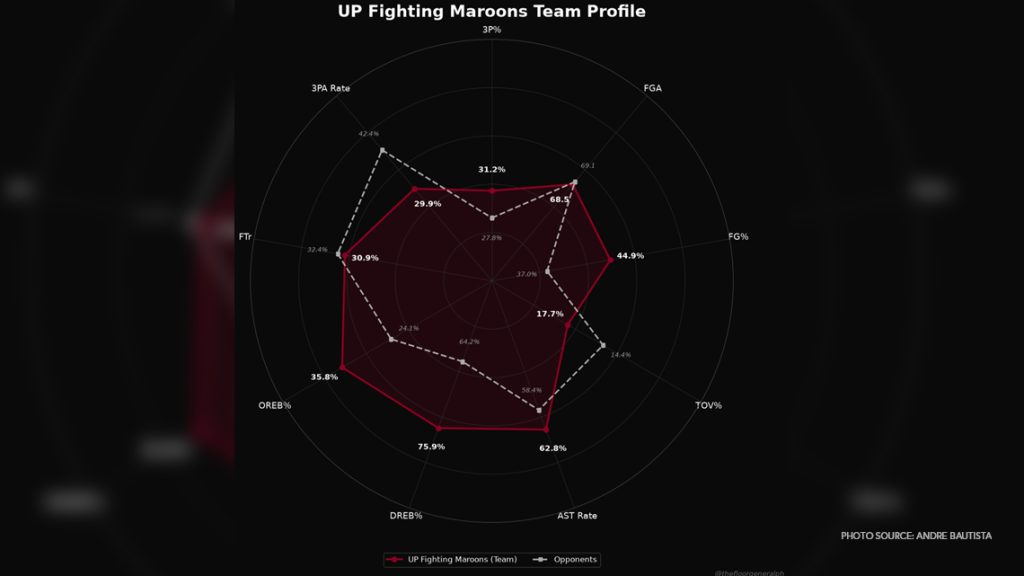
UP, meanwhile, brings plenty of strengths of its own. The Fighting Maroons have shot the ball well, competed consistently on the boards, and done an excellent job limiting opponents’ efficiency, all while providing quality playmaking on the other end.
Before we get to the main stars, let’s first shine a light on UP’s big men—Francis Nnoruka, Gani Stevens, and Sean Alter. All three have been remarkably efficient with their opportunities, shooting 62.1%, 76.7%, and 71.4% from the field, respectively. Stevens leads the trio with 8 points and 6.5 rebounds per game, while Alter adds 7.3 points and 4.4 boards. Even Nnoruka, despite playing just five games, has averaged 9.2 points and 4.8 rebounds. That kind of frontcourt efficiency has been a major reason why UP stands out offensively.
As for their stars—VJ Pre, Rey Remogat, and Jacob Bayla—their efficiency is naturally expected to take a hit given their offensive responsibilities. Still, their production is undeniable, with Pre averaging 11.6 points per game, followed by Remogat at 9.2 and Bayla at 7.2. Pre has been particularly efficient, shooting 48.1% from the field and 47.8% from three, showing exactly why UP brought him to Diliman.
On the other end, the Fighting Maroons hold the best defense in the group, holding opponents to just 92.7 points per 100 possessions and 37% shooting from the field. Nnoruka leads the team with 1 block and 0.8 steals per game; Bayla, one of the best on-ball defenders in the UAAP, adds 1 steal per game, and Remogat also averages 1.2 steals per contest.
Then there’s the playmaking. With an assist rate of 62.8%, much of UP’s offense naturally runs through Remogat, who averages 5.6 assists per game. He does an excellent job creating looks for his teammates, particularly the efficient big men mentioned earlier. The concern is his 3 turnovers per game, which contributes to UP’s relatively high 17.7% turnover rate.
Aside from that, there isn’t much to nitpick about this Fighting Maroons squad. They have efficient bigs, scoring options on the perimeter, multiple defensive playmakers, and one of the league’s best floor generals. If they can maintain that identity when the games start counting, UP has more than enough firepower to make another championship push.
FEU Tamaraws
The Tamaraws have shown plenty of promise throughout the preseason. Built around a young core that has steadily grown together over the years, FEU now looks ready to show just how far that development has taken them.
Standing at the center of it all is Mo Konateh. If there’s anyone capable of going toe-to-toe with Collins Akowe, it’s him. Konateh averaged 17.1 points and a team-high 12.3 rebounds per game across the preseason, doing so while shooting 58.6% from the field. He’s putting together the profile of an MVP-caliber big man—and somehow, he still feels a little under the radar.
Then there’s Kirby Mongcopa, who took a major leap last season and has continued that upward trajectory throughout the preseason, averaging 14.3 points per game. Add Jorick Bautista’s 12.1 points, UAAP Season 88 Juniors MVP Cabs Cabonilas’ 11.8 points, and reigning UAAP MVP Janrey Pasaol’s 10.7 points, and you have a group overflowing with talent.
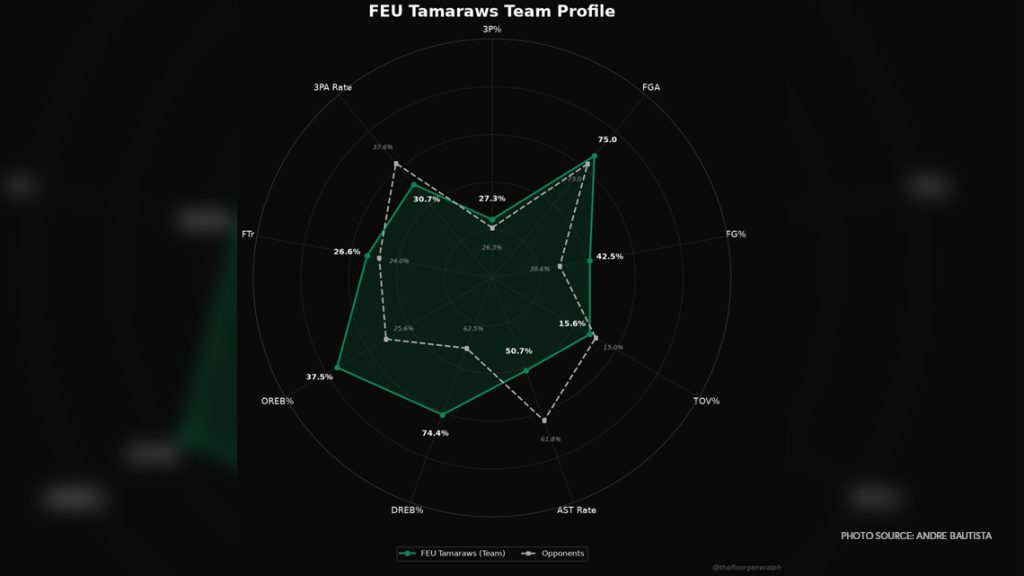
The Tamaraws also have no shortage of numbers on the glass also. FEU posted a 74.4% defensive rebounding percentage and a 37.5% offensive rebounding percentage, with Konateh anchoring the majority of that. Mongcopa ranks second on the team with 7.6 rebounds, while Cabonilas adds another 6.1. Simply put, FEU has plenty of bodies capable of winning possessions on the glass.
And it’s not just about rebounding. FEU owns the second-best defense in the group behind UP, allowing just 93 points per 100 possessions while holding opponents to 38.6% shooting from the field.
A huge part of that is also Konateh. He isn’t just a force on the offensive end—he’s also a major defensive presence, averaging 3.1 blocks per game. With that kind of interior presence anchoring the defense, opposing teams have to think twice before attacking the paint.
One area that might raise an eyebrow, though, is FEU’s assist percentage, which sits at around 50%. On paper, that seems surprising for a team with a player like Pasaol, who continues to establish himself as one of the best point guards in college basketball.
But context matters. FEU faced professional competition during the NSAC World Invitational, where the Tamaraws went up against teams with more experience and more established offensive systems. That could help explain why FEU’s assist numbers dipped against the overall preseason sample. It doesn’t necessarily point to a lack of playmaking—it’s simply a number that needs to be viewed alongside the level of competition.
And Pasaol’s individual numbers certainly suggest the playmaking is there. He averaged 5.1 assists per game while maintaining an assist-to-turnover ratio above two, giving FEU a reliable floor general who can consistently create opportunities for others.
Bautista provides another playmaking option, averaging 3.8 assists per game, while Mongcopa continues to show why he fits the point-forward mold. He can score, rebound, and facilitate, giving the Tamaraws another creator without taking the ball completely out of their guards’ hands.
Put it all together, and the case for FEU as a Final Four contender is hard to ignore. They have the scoring, rebounding, defensive presence, and playmaking to make a deep run—and perhaps most importantly, they have the hunger after narrowly missing out on the Final Four last season.
Ateneo Blue Eagles
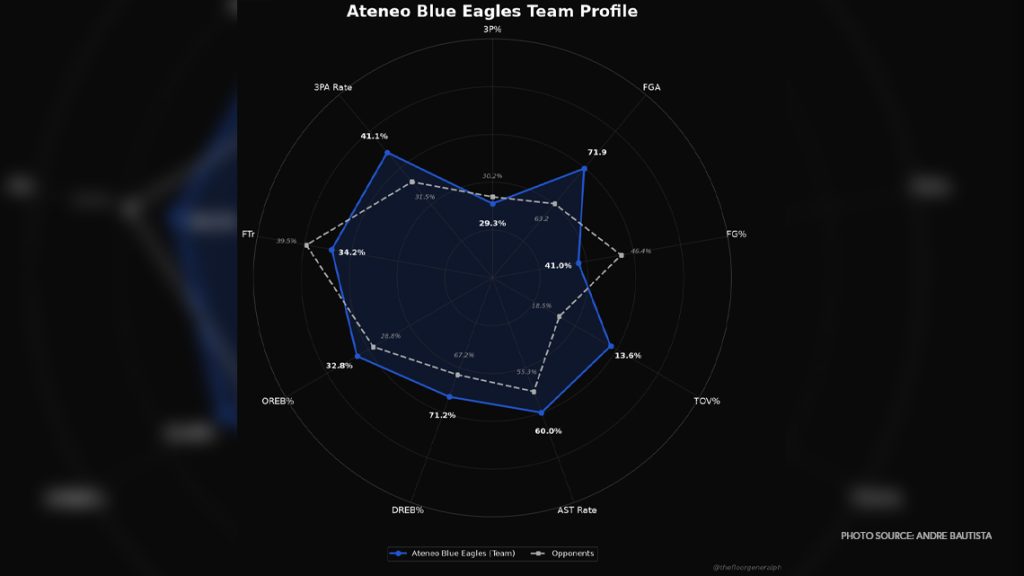
As mentioned before, the sample size for Ateneo is relatively small, but there’s still enough here to get a solid idea of the brand of basketball they’re likely to play.
As the graph shows, the Blue Eagles really like to “run and gun,” putting an emphasis on getting up plenty of shots, whether from the field or beyond the arc, even if it means sacrificing some efficiency in the process. A 41% three-point attempt rate shows just how much of their offense comes from three. They also place a strong emphasis on playmaking, reflected in their relatively low turnover percentage and high assist rate. After all, you can’t get a shot off if you don’t move the ball well.
At the helm of that offense is Kieffer Alas. Averaging 15.6 points per game on 45% shooting, the phenom looks ready to make the jump from top high school prospect to college star in no time. Behind him are Jared Bahay, Travis Roberts, and Shawn Tuano, giving Ateneo plenty of options to work with, with all three averaging at least 8.6 points per game.
A huge chunk of that offense came from beyond the arc. I mean, a 41% three-point attempt rate is insane. And the thing is, there isn’t even a single standout shooter carrying the load. Plenty of them can knock down threes—from Bahay, Alas, Tuano, Roberts, Drew Bongo, and Ian Espinosa. Tuano, in particular, shot 45.5% from three, while Bongo also connected on 34.6%, giving the Blue Eagles multiple threats defenses have to account for on the perimeter.
And speaking of Espinosa, he’s the head of the snake when it comes to the Blue Eagles’ playmaking as well, averaging 4.2 assists per game while taking care of the ball incredibly well. His 1.4 turnovers per game give him an assist-to-turnover ratio of exactly 3-to-1. Bahay, the primary playmaker on paper, is right there too, averaging 4.1 assists per game. Then there’s Alas, who chips in 2.4 assists per game but is primarily focused on the scoring.
Overall, you could say the Blue Eagles’ offense is good, ranking second in offensive rating behind UST at 105.3 points per 100 possessions. However, the efficiency still needs some work, especially considering the sheer volume of shots they’re taking. Defensively, they rank last among the seven teams we’re analyzing today, so that’s certainly another area they’ll need to address.
That said, given the small sample size, let’s treat this more as a glimpse of what Ateneo can really do on the court, especially with the talent and versatility they have across the roster.
NU Bulldogs
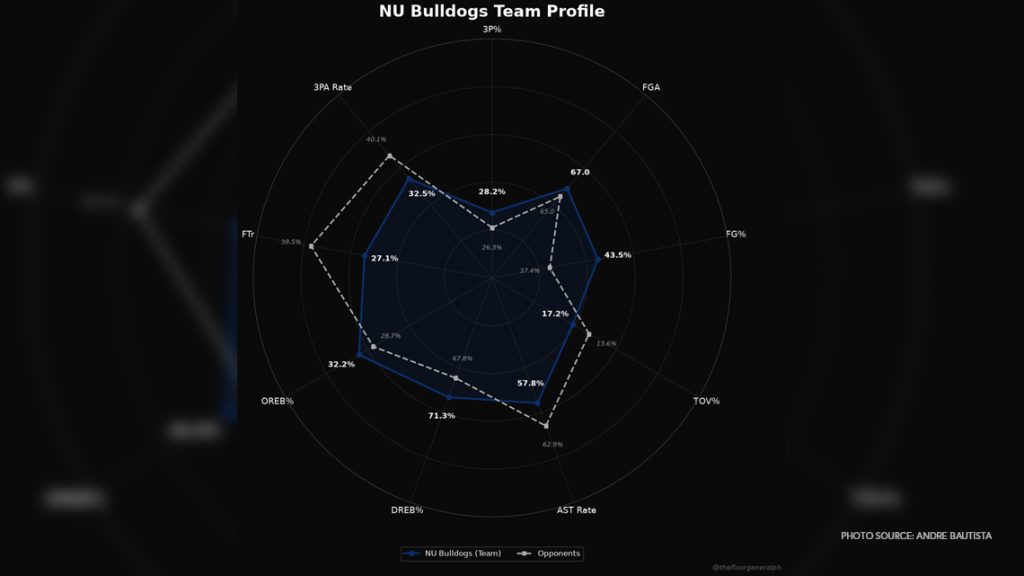
NU is a sleeper pick on almost everybody’s Final Four list, and despite the great competition and talent across the league, I wouldn’t count the Bulldogs out just yet.
Making their mark on defense, the Bulldogs rank third in defensive rating, allowing just 93.6 points per 100 possessions—only 0.6 points behind FEU. They also know how to make life difficult for opposing offenses, limiting teams to just 37.4% shooting from the field. On the other end, NU scores efficiently as well, knocking down 43.5% of their own field-goal attempts.
Holding it down for NU on the offensive end are PJ Palacielo and Reinhard Jumamoy, two of the team’s key pieces heading into the season. Averaging 12.1 and 11.8 points per game, respectively, they’ll have an opportunity to take on bigger roles following the departure of Jake Figueroa and Steve Nash Enriquez. Palacielo also gives NU a reliable perimeter option, shooting 38.7% from three, while Jumamoy provides another playmaking outlet with 3.4 assists per game. If the Bulldogs are to make a deep push this season, it’s going to be up to these guys to help lead the charge.
Another player you should take a look at is Mohamed Diassana, who is not only averaging 8.7 points on an impressive 63.4% TS%, but is also NU’s leading rebounder, crashing the glass and pulling down 9.8 rebounds per game. That includes 4.5 offensive rebounds a night, meaning he’s constantly giving the Bulldogs extra possessions and second chances. With Omar John out of the picture, the Bulldogs have another serviceable big they can rely on in the frontcourt.
Defensively, he can be a force as well, averaging 2.6 stocks per game between 1.3 steals and 1.3 blocks. That kind of activity gives NU another disruptive presence in the middle and on the defensive end, potentially challenging the likes of Mo Konateh and Collins Akowe, at least in this department.
Given the exits of several key players, it might seem weird to say that NU is in good hands. But actually, they are. People just haven’t realized it enough yet. That could be exactly what the Bulldogs need to surprise some people and get the attention they deserve—as long as they play to the level they’re capable of.
DLSU Green Archers
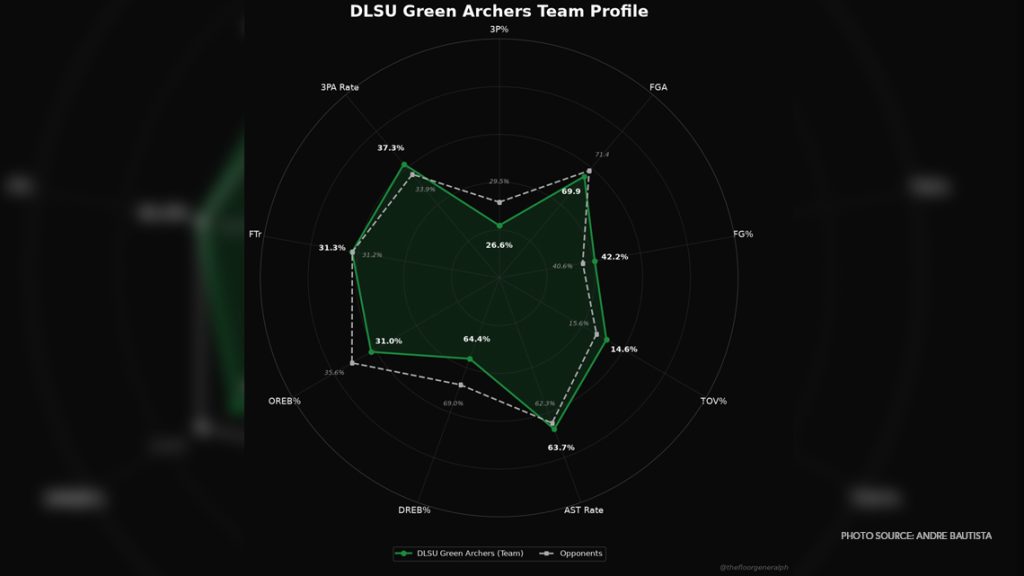
For the defending champions, the numbers may seem underwhelming, but simply put, the Green Archers just didn’t have the best preseason. Still, that’s no reason to overlook them.
Yes, they lost Mike Phillips, and this isn’t just losing any type of player, but one of the best the UAAP’s ever seen. Losing a player like that leaves a hole. And that’s what the rebounding numbers are saying in the graph.
On the brighter side, they still have Jacob Cortez, one of the best point guards in college basketball; Mason Amos, who we still haven’t seen at his best due to injury and who has a chip on his shoulder to bounce back; and a majority of the guys who played big roles on last year’s championship team.
That statement is well backed up by their scoring output. Cortez leads the Green Archers, averaging 13 points per game, with Amos right behind him at 10.6 while doing so on much better shooting efficiency. Then you have guys like Jcee Macalalag and Luis Pablo, who you can definitely rely on to contribute, averaging 8.9 and 8.6 points per game, respectively.
Additionally, Amos continues to show us what he can really do—stretch the floor and make defenses pay for leaving him open. He’s already attempted 4.4 threes per game, showing just how much La Salle is willing to use him as a floor-spacer. Cortez is definitely going to knock down his share of threes too, with most of them coming off the dribble, while you can always rely on Andrei Dungo to hit those timely shots when La Salle needs them.
And of course, when talking about La Salle, you can’t keep your mouth shut about Cortez. You can’t say he’s one of the best point guards in college basketball for nothing, right? He not only leads the Green Archers in playmaking, but you can make the argument that he’s the heart, soul, and engine of this team. Averaging 6.6 assists per game while posting an assist-to-turnover ratio above two, what more could you ask for? He’s not just creating opportunities for himself—he’s getting the entire offense moving.
However, with all this talk about the team, I have yet to bring up some important concerns. Since he only recently joined the Green Archers, highly anticipated recruit Joaquin Tovera is not accounted for in this analysis. He played for La Salle during their trip to Japan, but did not suit up for them in either Filoil or AsiaBasket.
Also, with the rebounding problem at stake, one man could be crucial in solving it—and that’s Luis Pablo. He showed flashes of his true potential in last year’s Finals, and we’re looking forward to seeing more of that from him this season as he steps into the role Mike left behind, at least to some extent. Pablo is already averaging 5.7 rebounds per game, including 1.5 on the offensive glass, so there’s certainly a foundation for him to take on more of that responsibility.
Despite the net rating they accumulated this preseason, they’re still contenders—and this analysis certainly isn’t counting them out. They’re the defending champions, after all.
Adamson Soaring Falcons
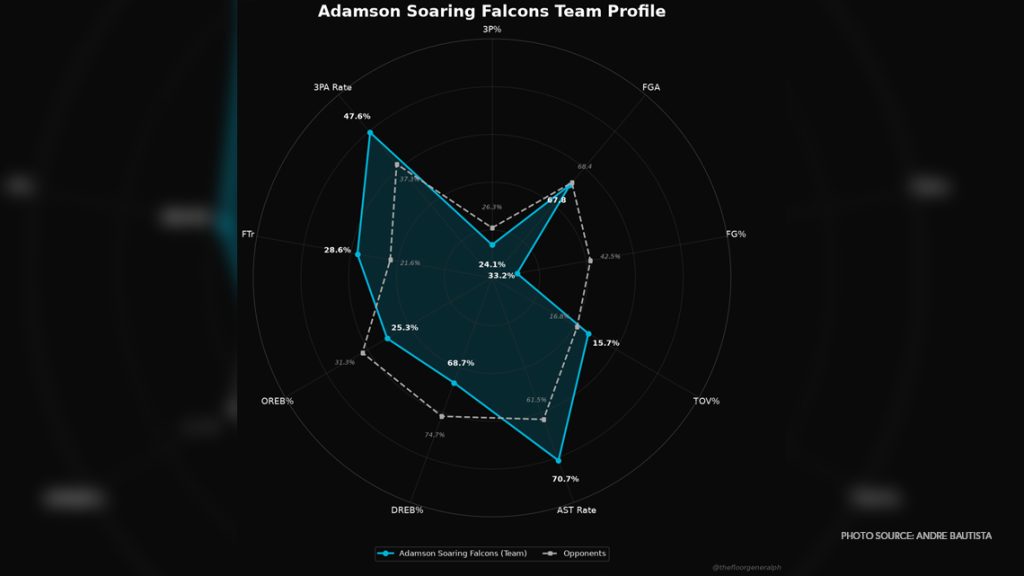
Not the best of preseason campaigns, and the stats in the graphs certainly show it—it’s a little bit all over the place. Still, there are some useful insights that can be taken from all of this.
Despite their overall team efficiency, there are plenty of bright spots for the Soaring Falcons when it comes to scoring. You have Matthew Erolon, Ray Allen Torres, Precious Jonah, EJ Anabo, Noah Pacquiao, and Mahathir Edding—all capable of turning the tide for Adamson whenever they desperately need a swing in momentum. Erolon and Jonah lead the way at 8.6 points per game each, while Torres adds 8.3 and Anabo chips in 6.7.
With a 47.6% three-point attempt rate—higher even than Ateneo’s—the Soaring Falcons can be dangerous from downtown, especially with the number of shooters they have at their disposal. Erolon and Pacquiao both attempt around five or more threes per game, while Torres is taking 6.6 per game. Pacquiao has been the most efficient of the three at 36.7%, while you also have Anabo and AJ Fransman, who we already know can definitely hit it from there.
Lastly, playmaking. As you can see from the team profile graph, Adamson has a 70.7% assist rate. On the other hand, the player numbers show just how well distributed the playmaking is across the team, which pretty much explains why the Soaring Falcons can post such a high assist rate. Torres averages 2.6 assists per game, Edding 2.9, and Montebon 2.4, while even players like Lance Mangaron and Erolon contribute two or more assists per game.
Overall, Adamson is a team built around collective play, but that hasn’t quite translated into success just yet. Rebounding remains a problem, too, although Jonah’s 6.0 rebounds per game and Fransman’s 4.4 give them some pieces to work with. Still, this is a team that’s definitely capable of pulling off wins—they just need to figure out how to put it all together.
Conclusion
While I would’ve liked to include the UE Red Warriors, there’s simply no preseason basis for doing so—we’ll just have to see when the season tips off.
But even without UE in the picture, the numbers have given us plenty to work with. UST looks like the team to beat, UP remains a powerhouse, and FEU and NU have made strong cases for themselves. Ateneo, despite the limited sample, has shown enough to suggest there’s plenty of potential there, while La Salle may not have had the best preseason, but they remain the defending champions for a reason. As for Adamson, the Soaring Falcons may still have some things to figure out, but their collective play and scoring options make them a team more than capable of pulling off a few surprises.
Of course, none of this guarantees anything. This is preseason-based, and once the games start counting, everything can change. Matchups, adjustments, injuries, momentum, and how each team responds when the pressure is on will ultimately tell us much more than any graph ever could.
The numbers give us an idea of what to expect. Now, it’s time to see who can actually deliver.
After all, the UAAP is full of surprises.
For more exclusivr basketball stories and updates, click here.