
From Cebu to the Nation: How CIFFA Is Helping Grow Flag Football in the Philippines
Ever heard of flag football?
While it may still be unfamiliar to many Filipinos, the sport has quietly built a passionate and growing community across the country, attracting students, working professionals, and first-time athletes to a game built on speed, strategy, and teamwork.
In Cebu, the Cebu Integrated Flag Football Association (CIFFA) is helping push that movement forward.
For CIFFA Chairman Siegfred Agraviador, the journey began after the pandemic, when he and others in the community noticed a decline in active players. With experience playing collegiate flag football and organizing university tournaments, Agraviador was invited by his friend Miguel Callorina to help revive the sport in Cebu.
What began as an effort to bring players back to the field has since developed into a bigger mission.
Building Cebu’s Flag Football Community
“From day one, our main focus at CIFFA has been growing the sport at the rookie level,” Agraviador told ALL-STAR.
Through rookie cups, camps, and support for university teams, CIFFA has created more opportunities for newcomers to discover the sport. Agraviador has since seen flag football expand beyond Cebu City into different towns and provinces, with younger players—including athletes in the 17-and-under age group—starting to join the community.
“We still have plenty of work to do to build up that youth division, but the momentum is definitely there,” he said.
Agraviador is also quick to emphasize that CIFFA isn’t doing it alone. He credits organizations such as the Cebu Flag Football League (CFFL), Ultimate Blitz League (UBL), Punk Panda League, and Sugbo Flag Football Club (Sugbo FFC), alongside local coaches and players, for helping the sport grow.
“We’re super lucky to have an amazing community around us,” he said. “Everyone plays a huge part in keeping Cebu flag football alive and growing.”
From Cebu to the Nation
That growing community will come together for the Cebu Festival Cup 2026, happening on September 12–13 at the Dynamic Herb Borromeo Sports Complex in Talisay, Cebu.
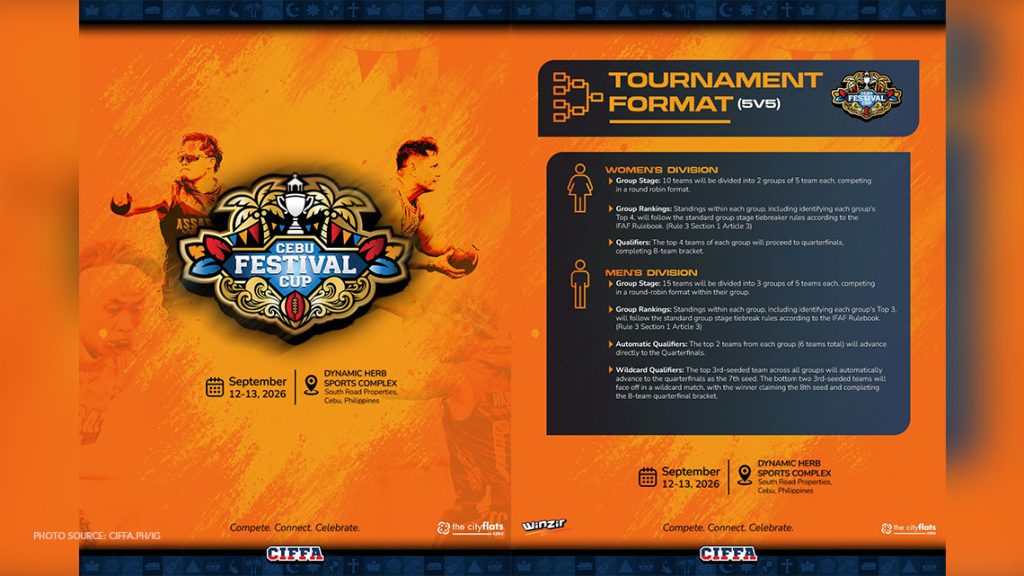
Men’s Division
Group A: Wolves International FFO, Manila Mamba, Huskies FFC, Assassins, Halyx Flockers
Group B: Pirates, Chunky Carabaos, Free Agents, Davao Legionnaires, Tropersee Ravens
Group C: Apex Apes, Panthers, Punk Panda Raiders, Mindanao Datus, Blitzkrieg
Women’s Division
Group A: Wolves, Shadow Claws, Grin Reapers, Huskies FFC, Hiraya
Group B: Savage Ladies, Lady Assassins, Chunky Carabaos, Mindanao Dayangs, Manila Supersonics
For Agraviador, the tournament is about more than competition. Its success could demonstrate that flag football is ready to be part of bigger athletic platforms in the Philippines.
“The big vision is to show everyone that flag football belongs in major athletic platforms, like CESAFI, the UAAP, and even Palarong Pambansa,” Agraviador said.
“Showing that we can run an international-caliber tournament right here in Cebu proves that the sport is ready for the big stage, not just locally, but nationwide.”
The Rise of Flag Football
Unlike traditional tackle football, flag football replaces tackling with removing a flag attached to the ball carrier, creating a fast-paced and more accessible version of American football.
Across Metro Manila, Cebu, and other parts of the country, leagues, tournaments, camps, and training programs are giving more athletes opportunities to experience the sport.
For CIFFA Vice Chair and Sponsorship Director Cherry Callorina, however, growing the game goes beyond increasing participation.
“For me, growing flag football means giving more people the chance to discover a sport they might never have known existed,” Callorina told ALL-STAR.
“When I started playing in college, I often had to explain what flag football was,” she added. “Those conversations made me realize that growing the sport is not just about winning games, but also about making people aware of its potential.”
A Pathway to the Global Stage
That potential is about to reach its biggest stage yet, with flag football set to make its Olympic debut at the Los Angeles 2028 Olympic Games.
For young Filipino athletes, the Olympics create a new opportunity to dream of representing the country through the sport.
Filipino representation in American football is already visible at the professional level, with players of Filipino heritage such as Camryn Bynum, Nikko Remigio, Andrei Iosivas, Tyler Allgeier, and Josh Jacobs reaching the NFL. Bynum, in particular, has strengthened his connection with the Philippines through camps and community initiatives.

Together, that representation and flag football’s upcoming Olympic debut offer aspiring Filipino athletes a glimpse of where the sport could potentially take them.
“I want to see a future where young athletes can discover flag football, develop their skills, and have opportunities to pursue it seriously,” Callorina said. “If we can help make that happen, then I believe we’re already making a meaningful impact.”
Building What’s Next
For Callorina, the long-term vision is to turn CIFFA into a pathway where athletes can start as beginners and eventually compete at higher levels.
“My vision for CIFFA is to become a place where young athletes can discover flag football, develop their skills, and grow with the sport,” she said.
“I want it to be a pathway for beginners to eventually compete at a higher level, while also creating opportunities for those who dream of becoming professional athletes.”
Ultimately, she hopes CIFFA can help create a future where flag football is more recognized, accessible, and supported by a stronger community in the Philippines.
From rookie camps and grassroots tournaments to welcoming international teams to Cebu, CIFFA’s growth reflects the possibilities emerging for the sport across the country.
For Agraviador, Callorina, and the wider Cebu flag football community, the bigger goal goes beyond championships: introducing more Filipinos to the game, creating pathways for young athletes, and helping flag football earn its place on bigger stages.
And from Cebu, CIFFA hopes to help take the game even further.