
What’s Wrong with La Salle This Season?
The De La Salle Green Archers are in a weird spot right now.
After losing to the Adamson Soaring Falcons last Sunday, they find themselves with a 3-4 record, currently sitting at sixth in the rankings.
As the defending champions, this is not exactly where they want to be. NU and UP have positioned themselves at the top of the Final Four race, while La Salle finds itself playing catch-up alongside Adamson, UST, FEU, and Ateneo.
With the first round now in the books, the numbers offer a clearer picture of why the Green Archers have struggled to separate themselves from the pack and what they need to address moving forward.
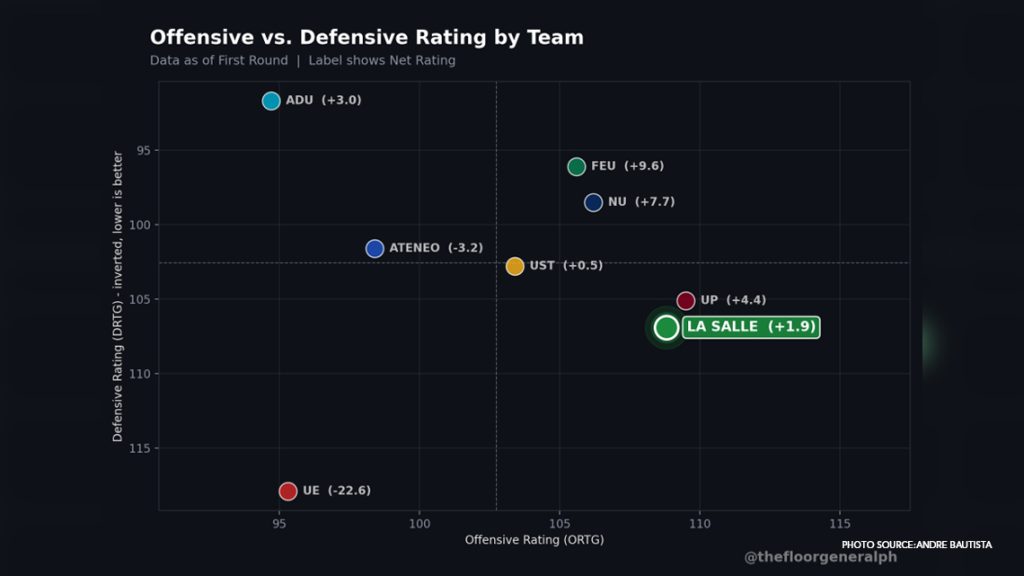
By plotting each team’s offensive rating (points scored per 100 possessions) against its defensive rating (points allowed per 100 possessions), we can calculate its net rating by subtracting defensive rating from offensive rating. This measures how many points a team outscores its opponents by per 100 possessions.
FEU leads the UAAP with a +9.6 net rating, followed by NU at +7.7 and UP at +4.4. Adamson is fourth at +3.0, while La Salle is fifth at +1.9. Still, the Green Archers have both Ateneo and UST on their heels, each within striking distance of overtaking them.
The Need for a Strong Start
For Luis Pablo, one of the pillars of this La Salle squad, getting out of this rut starts with bringing the energy and imposing their will from the opening tip.
“I think we just have to have a good start every game […] that’s our main focus right now,” he shared in an exclusive interview.
The numbers support Pablo’s point.
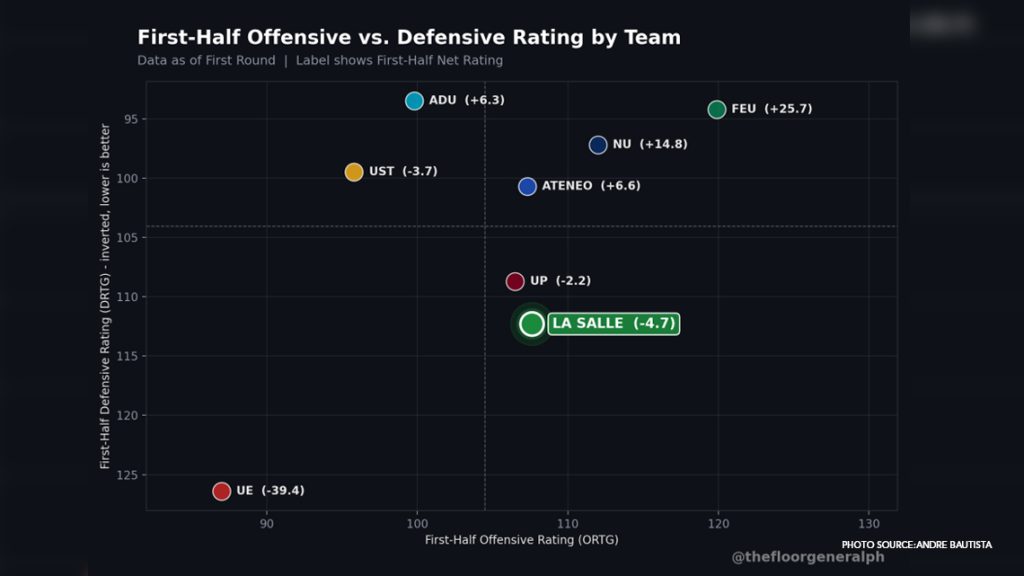
Looking at only the first half of each game, La Salle ranks second-lowest in net rating, getting outscored by its opponents by 4.7 points per 100 possessions.
Against UST, La Salle trailed by eight points after the first quarter and by five at halftime, 45-40. Against FEU, the Tamaraws led 52-38 at halftime. UP built a 42-28 lead at the break against La Salle. In their final first-round game, Adamson held a 36-28 halftime edge after the Green Archers had trailed by 13 in the first quarter.
All ended in a La Salle loss.
In contrast, the Green Archers led at halftime in all of their wins. They held a seven-point advantage against NU, 52-45, and a 19-point lead over UE, 61-42. Even in their tighter matchup against Ateneo, La Salle still entered the break ahead, 45-43.
This shows how important it is for the Green Archers to find their rhythm early and build the momentum they need to carry through to the final buzzer and come away with winning results.
Grabbing the Boards
Aside from getting off to better starts, Pablo pointed to another area the Green Archers need to address.
“We have to work on our defense, especially our rebounding.”
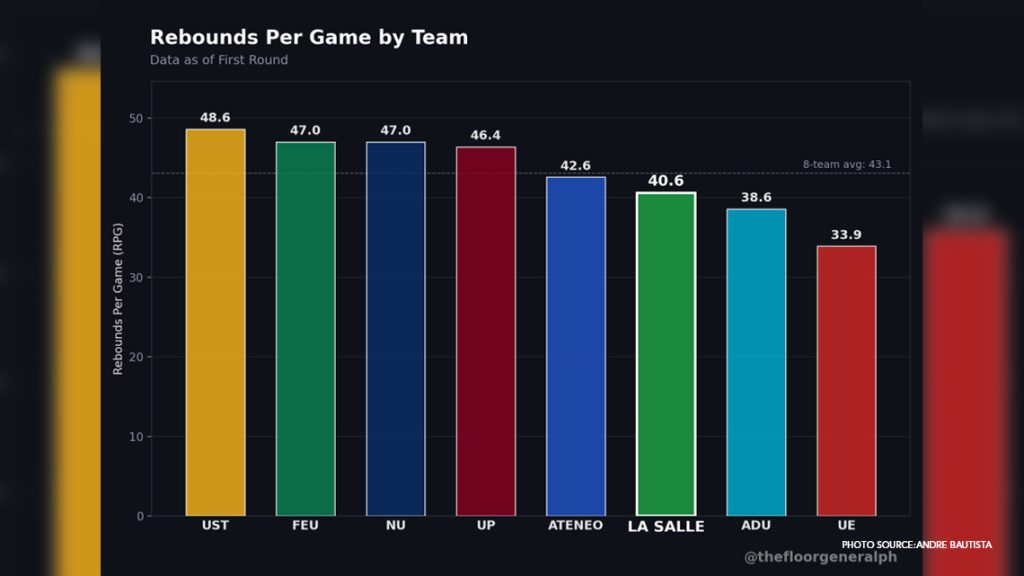
Looking at the graph, La Salle is the third-lowest team in rebounding so far, reinforcing Pablo’s point about the need to improve on the glass.
As the team’s leading rebounder, the 6-foot-7 big man shared his thoughts on what they need to do better.
“We just have to do a better job collectively. I think a rebound is all about effort. It’s not just about size,” he emphasized.
“Everyone has to be on the same page. Everyone has to want that rebound more than the other teams.”
They won the rebounding battle only three times: in victories over Ateneo, 44-38, and UE, 48-34, and against Adamson, which ranks below La Salle in rebounding average, in a game where the Green Archers nearly came away with a win, showing how important controlling the boards is in increasing their chances of coming out on top.
Balancing Both Ends of the Floor
Referring back to the first graph, two things stand out about this La Salle squad: it has the second-best offensive rating in the league, but also the second-worst defensive rating.
The Green Archers can light up the scoreboard, but they give up plenty on the defensive end as well.
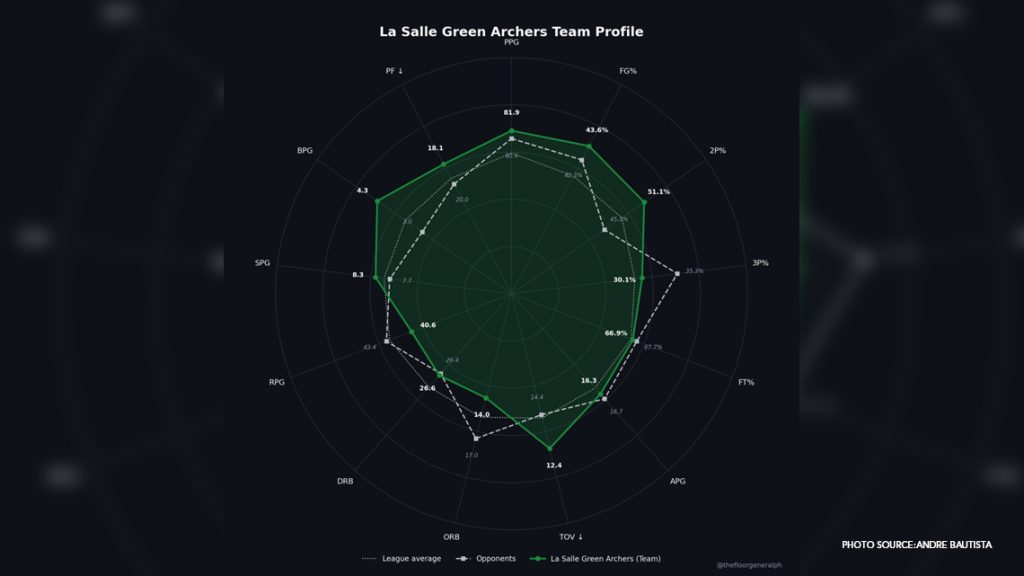
Based on this team profile, La Salle checks the boxes of a top-level offense, ranking above average in points per game and field goal percentage from both two-point and three-point range. Defensively, however, allowing opponents to shoot 35.3% from beyond the arc—the highest mark in the league—is a glaring problem.
As a result, opposing teams are averaging 7.6 three-pointers per game against the Green Archers. Given the value of the three-point shot, those conversions can quickly add up on the scoreboard.
To address this, Pablo echoes head coach Topex Robinson’s reminder that taking good shots on offense instead of settling for bad ones allows the defense to get set before opponents can attack them at the other end.
“It’s more about what Coach [Topex] has said. Our defense is our offense. As long as we try to get the best shots possible, it will help our defense.”
While La Salle has done a better job limiting opponents’ two-point shooting to below the league average, its focus on protecting the interior has left more room for opponents to crash the boards. The Green Archers allow 17.0 offensive rebounds and surrender 15.6 second-chance points per game, the second-highest marks in the league.
That’s almost a point per offensive rebound allowed, highlighting how costly those extra possessions can be for La Salle.
Given all of this, Pablo is well aware of the adjustments the team needs to make.
“We just have to study more, watch more of our games, and really analyze what areas we have to improve on.”
What the Standard Says
With the Green Archers struggling to find consistency this season, comparisons to last year’s championship run are inevitable. What has changed between the title-winning squad and the team currently trying to find its footing?
Perhaps the biggest difference is the departure of one player: Mike Phillips.
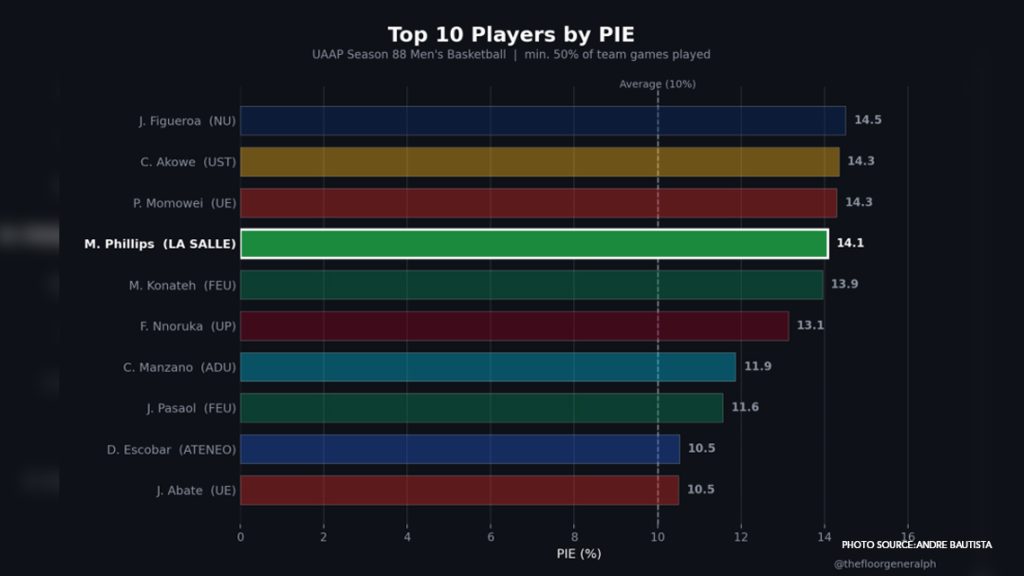
Using an advanced statistic called Player Impact Estimate (PIE), we can measure a player’s share of the statistical impact in the games he played. Phillips, last season’s Finals MVP, posted a 14.1% PIE, ranking fourth in the entire UAAP.
With his departure, La Salle has basically lost a player who accounted for 14.1% of the production in the games he played last season—a void that has been particularly evident in two areas where the Green Archers have struggled this year: rebounding and defense.
La Salle ranked fourth in rebounding last season, averaging 43.4 boards per game, slightly above the league average. The Green Archers were more effective on the boards with Phillips providing an added boost whenever he was on the floor. The same pattern holds on the defensive end.
While the difference was not particularly large, La Salle was still a better defensive team with Phillips in the lineup, finishing fifth in the UAAP last season with a defensive rating of 98.8 points allowed per 100 possessions. That proved enough to help carry the Green Archers to the championship.
La Salle does not need to lead the league in rebounding or defense to address its current shortcomings. It simply needs to improve in both areas. Pairing those improvements with an offense that already ranks No. 2 this season could go a long way toward getting the defending champions back on track.
Recognizing what Phillips brought to the team, Luis Pablo has taken some lessons from the former Green Archer and applied them to his own game.
“His energy is always there from the start of the tip-off to the end of the buzzer. I think that’s my main takeaway that I got from him: to try to impact the team in different aspects and, energy-wise, to just help boost the team.”
With that mindset, Pablo remains confident that the Green Archers can turn things around.
“I think we’ll be alright,” he said.
There is reason to believe they can. La Salle also didn’t have the best start last season, sitting at 4-3 before eventually finding its rhythm, reaching the Final Four, and going on to win the championship.
Now, the Green Archers find themselves at another crossroads. They have the offensive firepower to compete, but whether they can reproduce last season’s success may depend on how well they address the gaps that have held them back so far.
The standard has already been set. The challenge now is figuring out how to meet it again.
Before La Salle can return to the mountaintop, it must first confront what is keeping it from getting there.