
The New Guard
At 27 and 19, Elijah Cole and Kira Ellis represent a new wave of Filipino athletes built to last. Grounded in sport and style alike, they are also the faces of PENSHOPPE PLAY, Penshoppe’s latest activewear collection.
At first glance, their sports demand opposite instincts. One prepares for a single attempt where rhythm and timing decide everything. The other manages effort across hours, learning to stay composed long after fatigue sets in.
Yet for Elijah and Kira, performance is not something that appears only on competition day. It is something shaped daily through routine, discipline, and repetition.



Both compete internationally for the Philippines. Both train away from home. And both remain laser-focused on pursuing their goals, for the country they represent and for the athletes they are becoming.
Half-Filipino athletes are not new to Philippine sport. The stories, the questions, and the conversations around identity have been told before. But each generation carries it differently. For Elijah and Kira, representation is not something discovered late or explained loudly. It is simply lived.
As they begin to make names for themselves on international stages, they do so as part of a new wave of Filipino athletes shaped by global exposure but grounded in local identity. They are not exceptions to a pattern. They are its evolution. And as their careers unfold, they stand to become the kind of athletes younger Filipinos recognize not just as mere symbols, but as examples.
Built for the Moment
For Elijah, pole vaulting is built on routine, and early on, representing the Philippines disrupted that balance. “I do think there was a lot of mental pressure I put on myself,” he says. “I was thinking way too much about the country and not thinking about myself.”
He remembers how even encouragement became a distraction. “I literally remember running down the runway and hearing people shouting ‘Go Philippines!’” he recalls. “And I thought about that and didn’t think about jumping.” With time, that relationship with pressure shifted. “This time around,” Elijah says, “I kind of learned to embrace it a little bit more.”

Kira’s challenge unfolds differently. Triathlon offers no single defining moment, only sustained effort. “Triathlon’s not a sport where you train hard one day and then slack off for seven more days,” she says. “You’d rather be okay every single day.” she quickly adds.
Competing against global standards, both athletes look beyond local benchmarks. “I want to be amongst the best in the world,” Elijah says, a mindset shaped by the standards already set by leaders like EJ Obiena, whose presence has redefined what Philippine pole vaulting can look like on the global stage. Kira, just 19, understands the long view. “Triathlon peaks later,” she explains.
That perspective shaped how she handled the pressure of the 33rd SEA Games. “The main thing was just don’t burn out,” she says. “I really just focused on what I could control.”
Elijah returned from the 33rd SEA Games with a bronze medal. Kira, just 19, finished the competition with two golds and three silvers across her triathlon events. Different paths, the same forward momentum.

At their ages, both already operate with the mentality required at the highest level. Not just the confidence to compete, but the discipline to commit to the work that exists long before results are visible. Their performances point to an early understanding of what elite sport demands: consistency, sacrifice, and the willingness to give up comfort in pursuit of progress. Even now, they have begun to grasp what it takes to scratch the surface of the top tier, and they continue to build toward it deliberately.
A Common Goal
What comes next is not framed as a deadline, but as a direction, one that continues far from home. Both Elijah and Kira return to training environments outside the country, where preparation is quiet, demanding, and largely unseen.

The goal, however, remains clear. “That’s my dream,” Elijah says. “That’s my goal, to make it to the Olympics and represent the Philippines on the biggest stage possible.”
Kira speaks about it with the same clarity, tempered by patience. “As a kid I’ve always dreamed about competing in the Olympics,” she says. “There’s still time.”
Whether their paths eventually meet on the sport’s biggest stage, the Olympic Games, remains unanswered. Will it be Los Angeles in 2028, or further down the line in 2032? For now, both return to the work, building toward it from afar, letting preparation lead long before expectation ever does.
Work meets (Penshoppe) Play
Away from competition, the rhythm doesn’t disappear. Training, recovery, and comfort still shape the day. “I really just wear sports clothes,” Kira says. “My closet is like puro all sports.”
In a humid climate, comfort isn’t a preference. It’s practical. “I tried wearing jeans and hoodies once,” she laughs. “I was baking on the inside.”

Elijah traces a similar shift. “I grew up with just anything that the university gave me,” he says. “But this is like a different world for me now.” That overlap between training and everyday life is where movement becomes less about performance and more about continuity.
It’s also the space where Penshoppe enters with PENSHOPPE PLAY, an activewear line designed for people who move in their own way, without prescribing what being active should look like. For Kira, the connection feels intuitive. “The way they approach it really fits both their mission and mine,” she says. “It just aligns naturally, and I’m really grateful for that.” Elijah echoes the same ease. “It’s a perfect blend of my two worlds,” he says, where sport and life no longer need to change gears between them.
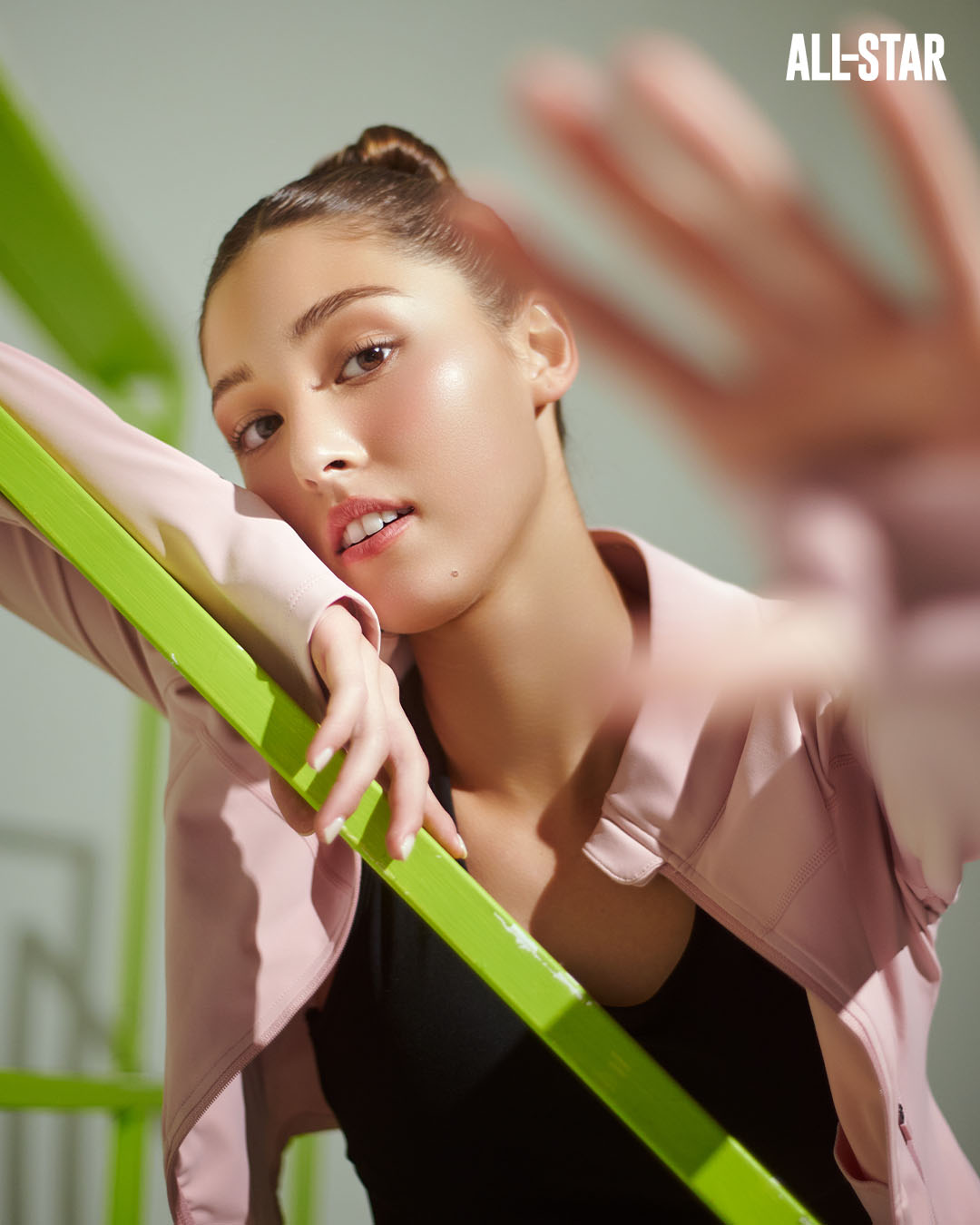
Elijah and Kira do not compete in the same arenas, nor under the same physical demands, but they share a standard shaped by preparation, composure, and patience. Their progress has never been sudden. It has been built through repetition, intention, and a clear understanding of what elite sport asks in return.
What sets them apart, however, goes beyond performance. In the way they carry themselves, in the discipline behind the work, and in the ease with which they move between sport and life, they represent a new image of the Filipino athlete. One that younger athletes can look toward not only for inspiration, but for possibility. One that reminds supporters, partners, and patrons alike that excellence can be both compelling and sustainable.
Whether their journeys lead to greater podiums or simply longer careers, Elijah and Kira are already part of a shift. They elevate their respective sports by being visible, grounded, and intentional. And as a new generation watches closely, what they offer is more than results. It is a standard worth aspiring to, and a future worth investing in.
Check out and shop PENSHOPPE Play, available now.
IN THIS STORY:
Publisher: James Leonard Cruz • Art Director: Karlota Tuazon • Photographer: Noel Monzon • Interview & Writer: Juan Marco Matriano • Social Media: JC Arnobit • HMUA & Styling : Penshoppe • Special thanks to Penshoppe