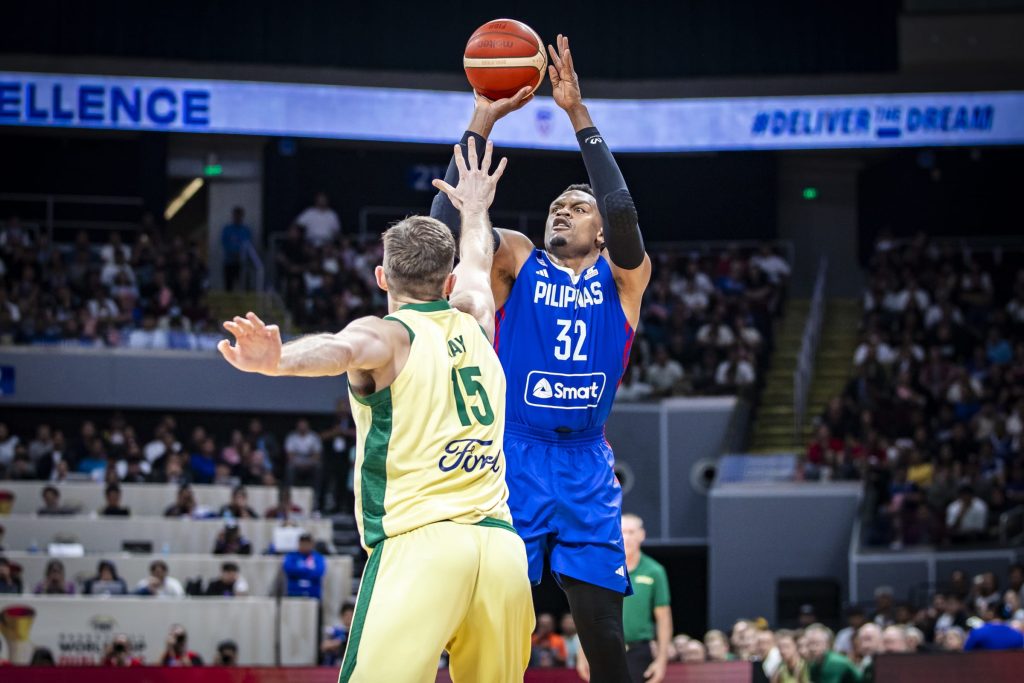
The Standard Australia Set, The Lesson Gilas Learned
Photo Source: FIBA
The noise at Mall of Asia Arena didn’t fade all at once. It thinned like ice melting on a hot summer day.
At halftime, with Gilas Pilipinas down only five to the fifth-ranked team in the world, the building still believed. Australia had 38 points. The Philippines had dictated tempo, contested shots, stayed attached on the perimeter. For a team that prides itself on defense, it looked like the blueprint for a puncher’s chance at an upset.
Then came the first possession of the third period.
A turnover. A three-point play the other way. A quick stretch of space. And in a matter of minutes, the game tilted from manageable to mountainous. By the time the quarter settled, the Boomers were running downhill. They would score 55 in the second half. The final would read 93–66, another large margin of victory in what’s been a one-sided series for both countries in FIBA action.
Tim Cone did not search for complicated explanations afterward. He searched for a feeling.
“It was a very painful one,” he said. Not angry, nor embarrassed.
Painful.
“Painful to be a part of, painful to watch, especially in front of our home crowd.”
The word lingered because this was not just about execution. It was about expectation. Seventeen thousand fans had come to see if Gilas could measure itself against Australia. Maybe some of them knew the inevitable end. But hope is a tricky thing. Sometimes, its pays off. We live for the moment when it does.
For two quarters, it did. For two quarters, the defense held. They had survived Elijah Pepper. They knew where the shots would come from. They understood the ball movement that has long defined the Boomers program.
“We had Pepper in our sights,” Cone said. “But we couldn’t stop him.”
Pepper finished with 28. Australia finished with 15 threes. And what had been a two-possession halftime deficit became a lesson in depth, precision, and urgency. The Boomers don’t rebuild. They reload. They space the floor. They move the ball. They punish hesitation.
Cone understood the standard across from him.
“They’re the number five team in the world,” he said.
It wasn’t framed as an excuse. It sounded more like a measuring stick.
After all, this wasn’t even Australia’s best lineup.
The Philippines had been together for ten days. The complete roster had only a few full practices intact. Cone believed the energy was right. He believed the defensive intent was real.
“I felt like we should’ve had the lead at halftime,” he said.
But this team, as constructed, does not believe it can win in a track meet against Australia or New Zealand. That is not its identity. Cone has been clear about that since taking over the program. Gilas is supposed to defend first and let that defense ease the burden on the offense.
They held New Zealand to 69 earlier in the window. They held Australia to 38 at the break. There is the formula to compete.
When the defense slips, even briefly, the margin disappears.
“You see the moment you don’t defend, the game can get away from you in a hurry,” Cone said. “And that’s exactly what happened.”
The outside naysayers have questioned whether Gilas has enough shooting. Cone rejects that. Dwight Ramos. Juan Gomez de Liaño. Justin Brownlee. Kevin Quiambao. Calvin Oftana. He pointed them out. One can even add CJ Perez.
“The problem isn’t that we don’t have shooters,” Cone said. “It’s generating the shots we want.”
There is a difference between rhythm and desperation. In the second half, Australia dictated both.
Cone admitted something else, too. The edge wasn’t identical to the New Zealand game two days earlier. Fatigue plays a role in a compressed window. So does disappointment. Against Australia, the first-half energy was “tremendous,” he said. But sustaining that against a top-five program requires near-perfection.
“You’ve got to be at the top of your game,” he said. “And we weren’t.”
The loss hurt more because of where it happened. Cone circled back to that repeatedly. At home. In front of their crowd. In a building that expected something different. In front of fans who played their own part in shot clock trickery.
But he also widened the lens.
Qualification is a longer arc. The Middle Eastern matchups later in the year will shape the real path forward. July will bring road games for the next World Cup qualifying window in colder gyms in New Zealand and Australia. Adjustments will come. Simplification, perhaps. Cone admitted he may need to look again at the offense and streamline it, create clearer reads, cleaner looks. Back to the basics.
“It’s back to the drawing board a little bit,” he said.
For a game and a half in this window, he was proud of the defense. That matters to him. That exact identity has always resonated strongly with this multiple-time champion mentor who has the honor of being considered the “Greatest of All Time” in his profession in the Philippines. A status that’s going to be secure for a while, maybe forever.
Gilas does not believe it can outshoot Australia. It believes it can out-discipline, out-grind, out-defend. When that slips, the gap between good and elite widens quickly.
It’s when hope falters.
The scoreboard showed a rout. The first half suggested something closer. Somewhere between those two realities is where Gilas Pilipinas lives right now.
The arena emptied slowly. The noise thinned. The pain remained. But so did the standard.
RELATED: Our feature after Gilas’ last defeat to New Zealand.