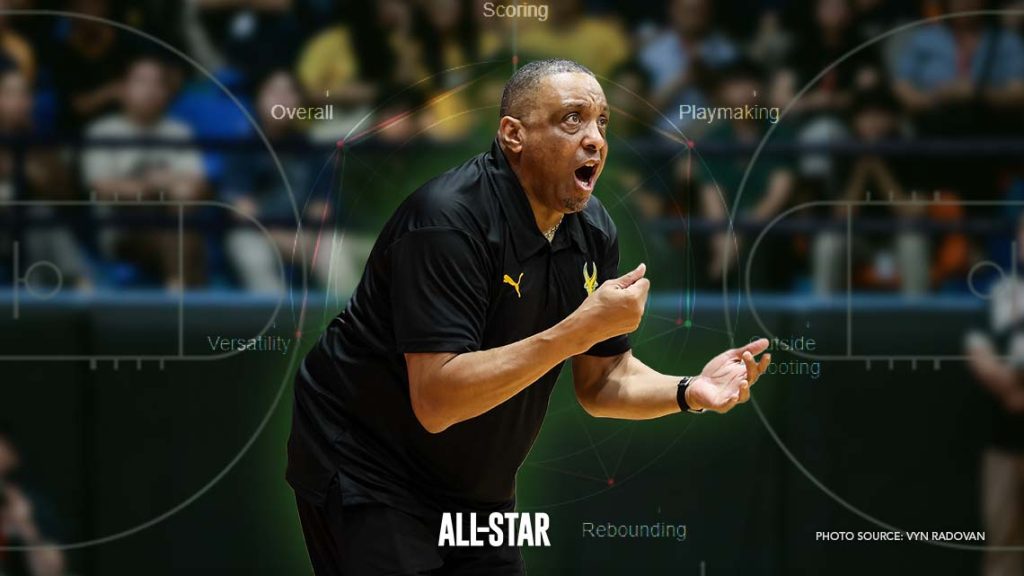
How Sean Chambers Balances Traditional Coaching and Analytics
When FEU was pulling away from UE in their first-round encounter, Sean Chambers was watching more than the scoreboard.
The Tamaraws were making stops, forcing turnovers, and turning those defensive possessions into fast-break points.
But Chambers had another question in mind: How often was FEU getting into the paint, and what happened when it did?
“One of my focuses was to sit and watch the game,” Chambers said. “I wanted to watch how many times did we touch the paint and kick out, and how many times we get the ball near the basket or near the rim, and then see the effect it had on our game.”
For Chambers, that is where analytics fit into coaching: not as a replacement for basketball fundamentals, but as another way of understanding whether those fundamentals are actually translating onto the court.
While many basketball programs have analytics teams working alongside their coaching squads, Chambers handles much of that responsibility himself.
“Yeah, it’s me,” Chambers said when asked if he has an analytics team.
It is an approach that reflects the balance at the heart of his coaching philosophy.
Embrace the numbers, but never lose sight of the habits and principles that win basketball games.
That balance has become particularly important for a young FEU Tamaraws squad looking to build on a 7-7 campaign in UAAP Season 88, where they made a late push for the Final Four before narrowly missing out and finishing fifth.
The Tamaraws carried that momentum into the preseason, posting a +9 net rating—the third-best mark among UAAP teams—and becoming one of only three teams to rank above average on both offense and defense.
Related: UAAP Season 89 Men’s Basketball: Data-Driven Preseason Preview
With FEU serving as hosts of UAAP Season 89, expectations have only grown.
But for Chambers, the numbers can only tell them so much.
Beyond the Box Score
FEU’s season did not get off to the start it had hoped for.
The Tamaraws surrendered a late lead against the Adamson Soaring Falcons in their opener, beginning their campaign with a loss. Nearly two weeks later, however, FEU responded emphatically, overwhelming the UE Red Warriors in a 23-point rout.
The turnaround reflected one of the central principles of Chambers’ coaching philosophy: defense.
“Like any winning coach, you want to establish a defensive mindset where you focus your wins and losses on making defensive stops, making your defensive habits the focal point, and letting the offense take care of itself,” Chambers said.

Against UE, that philosophy translated directly onto the floor.
“If you look at the game against UE, we made stops, and we had made most of our points on turnover or fast break points,” Chambers added.
But Chambers does not stop at the final score when evaluating a performance.
One of the metrics Chambers was tracking was the Tamaraws’ ability to string together three consecutive defensive stops, also known in basketball lingo as a “kill.”
“One of the things we took notes on was trying to make three consecutive stops in a row,” Chambers explained. “The analytics [say] you need to make three consecutive stops in a row, and then it starts all over again.”
A foul or an opponent’s basket resets the sequence, meaning the team has to start building toward three straight stops again.
For Chambers, the goal is to sustain them.
“Analytics says that if you can make seven in a game, you should probably win between 15 and 20 points per game,” he said.
The metric gives the Tamaraws a tangible defensive target to chase while the game is unfolding.
Chambers can use the numbers to track whether the team is building the kind of defensive stretches he wants.
Chambers was also tracking the Tamaraws’ offensive execution: how often they touched the paint, kicked the ball out, got the ball near the rim, and were able to penetrate and get downhill.
Those details may not always appear in a traditional box score, but for Chambers, they help provide a clearer picture of how FEU was playing beyond the final score.
But Chambers is also careful about how much authority he gives the numbers.
“You follow your analytics and use those numbers to try to improve your overall game. But at the end of the day, hard work, playing at 100%, will always defeat analytics. It’ll defeat talent. That wins the game,” Chambers declared.
Believing in the Players
If analytics help Chambers understand what his team is doing, his belief in his players helps him see what they can become.
“This is the ideal team you want to be able to make a run with. You have some really talented veterans: Janrey Pasaol, Jorick Bautista, Kirby Mongcopa, Mo Konateh…. We have some really good, talented guys returning back,” he shared.
“Then you mix that in with these really good five freshmen. We have the making of doing something special this year.”
That belief is reflected in the way Chambers talks about his players. Not simply in terms of what they have already produced, but in terms of what they can still add to the team.
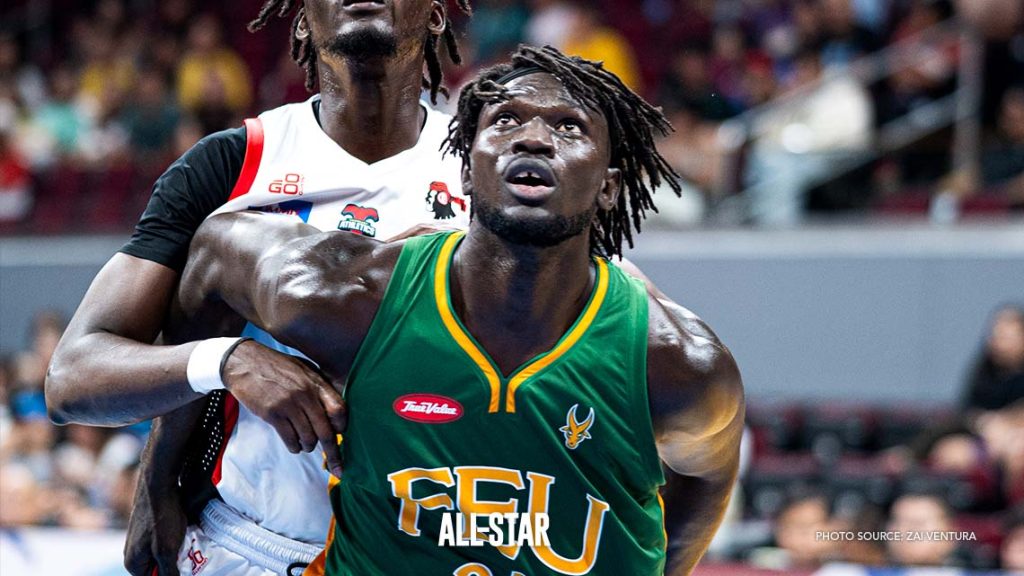
Mo Konateh, for example, gives FEU a presence that shows up across multiple statistical categories.
The big man averaged 17.1 points, 12.3 rebounds, and 3.1 blocks during the preseason, highlighting the all-around impact that makes him one of the Tamaraws’ most important pieces, and a candidate for the UAAP’s best FSA distinction.
Against Adamson, however, Konateh was limited to just five points and three rebounds. Against UE, he bounced back with 15 points and nine rebounds on 7-of-9 shooting from the field, despite being limited by foul trouble.
Chambers was quick to recognize the difference.
“Mo’s improvement is tremendous from year to year. [Against UE], we were really able to establish him at the beginning of the game until he had to sit for some fouls.”
“He’s a stat stuffer, like he rebounds. He was seven for nine. He should have gotten more shots if he didn’t have to sit so long. Mo is a hard worker. He’s really smart. He’s really intelligent. And he just does everything the right way.”
Kirby Mongcopa offers another dimension.
Averaging 14.3 points, 7.6 rebounds, 2.8 assists, and 1.2 steals during the preseason, Mongcopa has shown the versatility to influence the game in several ways, which is a valuable trait for a player capable of operating as a point forward and a potential league MVP.
“I think Kirby is one of the most unique players in the whole league, being that he can be a tremendous ball handler with unbelievable skills with the ball. He can score on many different levels. He has such a high IQ,” Chambers shared.
Mongcopa struggled against Adamson, scoring just four points on 2-of-11 shooting while committing six turnovers. But against UE, he responded with 13 points, 13 rebounds, and six assists.
“[Against UE] is when we saw what we truly got from Kirby. He felt he wasn’t very happy with his game against Adamson. He came back and bounced back. 13 points, 13 rebounds, and six assists; that’s pretty impressive.”
Then there is Janrey Pasaol, the reigning UAAP MVP.
Chambers continues to look beyond what Pasaol has already accomplished.
“Janrey is still one of the best pick-and-roll guards in the league. He’s really focused on his defense,” Chambers said, referring to Pasaol’s performance against UE. “I was really happy with his defense in the first half. He’s still one of the best [in terms of] court vision of any kid I’ve ever seen. And when he’s locked in, Janrey is a hard cover. He’s really talented.”
Pasaol led the UAAP in assists last season, averaging 7.5 per game, and also topped FEU during the preseason with 5.1 assists per game. Through two games this season, he is tied for the league lead in assists with UST’s Amiel Acido at 5.5 per game.
Habits Over Results
For all the data Chambers tracks and the talent he sees on his roster, he continues to bring FEU back to the same idea: habits.
“We’re focusing on habits more than we’re focusing on just one game. Do your habits, and they’ll take care of themselves.”
It is a philosophy that ties everything together.
The numbers can tell Chambers whether FEU is getting into the paint, creating turnovers, generating transition opportunities, or producing across multiple areas of the game.
Film can show him how those possessions unfolded.
But ultimately, it is up to the players to turn those observations into consistent habits.
FEU still has 12 elimination-round games to put those pieces together.
For Chambers, the numbers are there to help explain the game, but not define it. The Tamaraws’ challenge now is to turn those numbers, habits, and belief into a team capable of taking the next step.