
How is Alas’ System Different from Baldwin’s at Ateneo?
The Ateneo Blue Eagles have shown promise, but can they sustain it?
Ateneo edged the FEU Tamaraws, 75-72, before outlasting the NU Bulldogs, 69-65, to start the second round. The victories came against two teams that, at one point, occupied the top two spots in the standings.
However, the Katipunan-based squad stumbled in its next outing, falling to the DLSU Green Archers, 73-76, in overtime last Saturday.
With the loss, the Blue Eagles dropped to 5-5 and remained fifth in the standings, just outside the Final Four picture as they continue their push for a playoff spot.
Ateneo had a mixed first-round campaign, opening with a 3-1 record before dropping three consecutive games to close out the round.
Still, their recent victories offer reason for optimism. The win over FEU, which handed Ateneo a 23-point beating in their first-round meeting, highlighted the adjustments the Blue Eagles have made since then. Their victory over NU, whom they also defeated in the first round, provided another opportunity to show that they can string together consistent performances.
The rematch against La Salle, meanwhile, presented another chance to overcome a first-round setback. Although the Blue Eagles kept the game closer this time around, the result remained unchanged.
With four crucial games left in the elimination round, Ateneo will look to bounce back and build on its recent improvements as it seeks to strengthen its position in the Final Four race.
Sticking to the System
For things to fall into place for the Blue Eagles, lead guard Jared Bahay emphasized the importance of sticking to head coach Louie Alas’ system, which is built around running the offense through the guards.
“Coach Louie’s system revolves around guards. So, it’s very important, especially sa amin, na mag-control sa laro,” Bahay shared in an exclusive interview.
And control the game he did.
Bahay currently ranks seventh in scoring this season, averaging 14 points per game on 53.6% true shooting, while ranking fifth in assists with 3.8 dimes per game, establishing himself as one of the UAAP’s top guards.
To further put his scoring performance into perspective, here’s a look at how his shots have been falling this season.
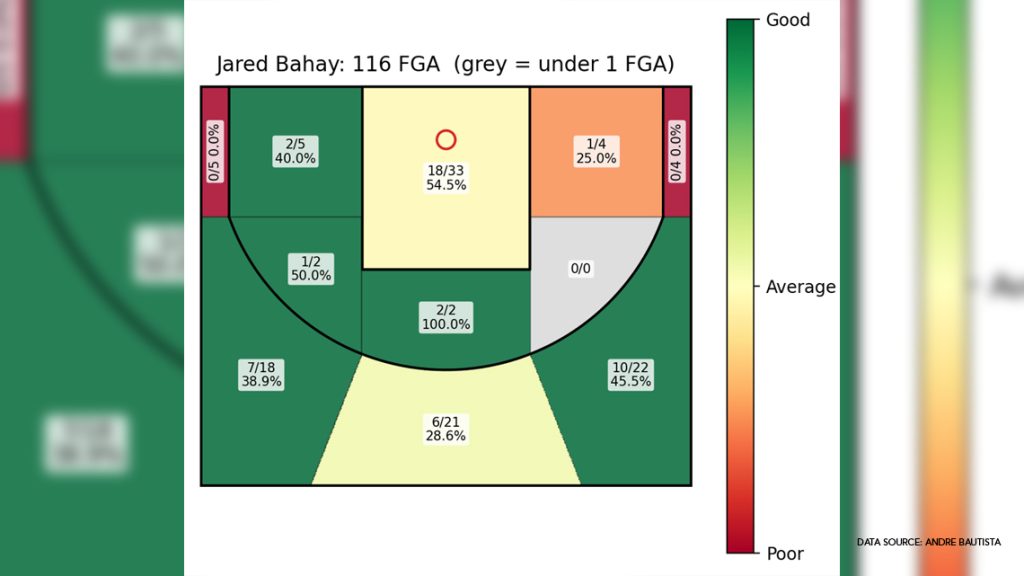
Bahay has been a threat from beyond the arc this season, particularly from the wings, where he is shooting way above average from three. He has also been effective from midrange while finishing 54.5% of his attempts in the paint, an impressive mark for a point guard, especially given his size.
This kind of performance reflects how well Bahay fits into Coach Louie’s system. With a 25.6% usage rate, meaning he is responsible for roughly a quarter of Ateneo’s offensive possessions while on the floor, Bahay’s value goes beyond scoring, as he also plays a key role in creating opportunities for his teammates and controlling the pace of the game.
“Very grateful ako kay Coach Louie kasi sobrang laki ng trust niya sa akin,” Bahay shared regarding his role.
But Bahay is not the only guard in this guard-based system.
Kieffer Alas, formerly ranked the No. 1 high school recruit in the country and currently a frontrunner for the Rookie of the Year award, has also been finding his footing in the system, making the most of the opportunities given to him.
And no, it’s not simply because his father is the coach. Kieffer has shown that his place in the rotation is backed by his own skill and talent, translating his abilities into meaningful contributions on the court.
And by meaningful, I’m talking about ranking third in the league in scoring kind of meaningful. Kieffer is putting up 15.8 points per game, the third-highest mark in the league, while also ranking second in steals with 1.8 per game, behind only Adamson’s Mathew Montebon.
With a 29.4% usage rate, the highest among the Blue Eagles and even higher than Bahay’s, Kieffer has taken on a significant role in Ateneo’s offense. He also leads the team in minutes played, and with the production he has shown, he has certainly earned that workload.
It comes with a catch, though.
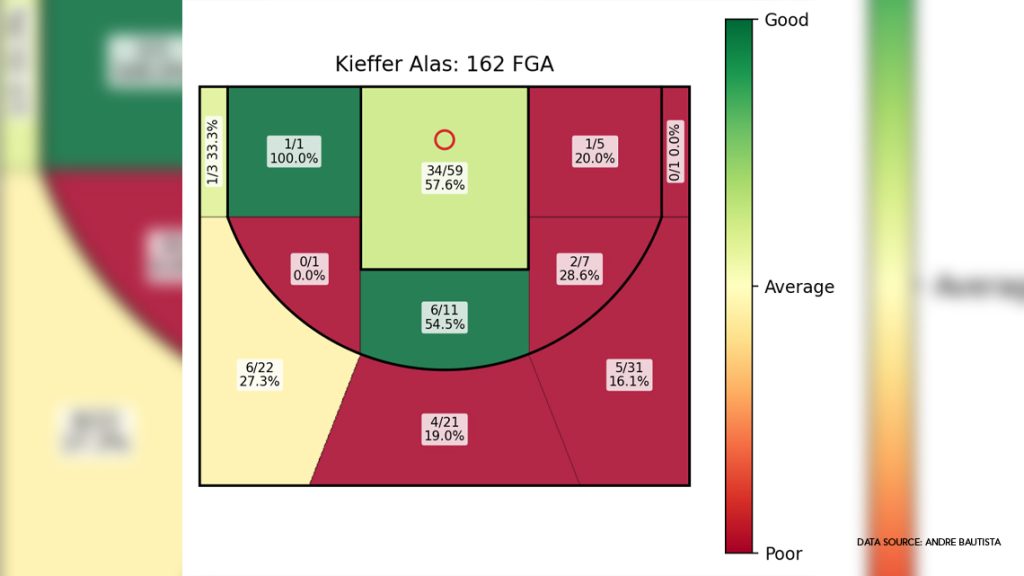
As seen in his shot chart, Kieffer has struggled with his efficiency, shooting just 37% from the field. Concerns remain over his shot selection, and although he has the confidence and ability to take difficult shots, knowing when to take them and when to look for better opportunities will be crucial to improving that side of his game.
Kieffer showed signs of improvement through the first two games of the second round, shooting exactly 46.7% from the field against both FEU and NU. He was particularly efficient against the Tamaraws, shooting 42.9% from three and 80% from the free-throw line. While he struggled in both areas against the Bulldogs, he delivered when it mattered most, knocking down a clutch three-pointer and free throw to help seal the victory.
That efficiency did not carry over against La Salle. Kieffer scored 18 points on 8-of-22 shooting (36.4%), including 1-of-12 from three, while playing 35 minutes and taking the most shots on the team.
Given those numbers, Kieffer’s ability to improve his shot selection and return to his recent shooting performances could prove crucial as the Blue Eagles push for a spot in the Final Four.
To round out Ateneo’s group of guards, we have Ian Espinosa.
Although his production may not be as flashy as Bahay’s and Kieffer’s, Espinosa’s impact goes beyond the box score, as he serves as a trusted option to run the offense off the bench.
Playing 19.6 minutes per game off the bench, Espinosa averages 3 assists against 1.3 turnovers, giving him the best assist-to-turnover ratio among Ateneo’s guards. He has also been reliable at the free-throw line, converting 16 of his 18 attempts. While he has yet to find his rhythm as a scorer, shooting just 32.4% from the field, his ability to take better care of the ball makes him a reliable secondary playmaker for the Blue Eagles.
His role reflects the trust that Coach Louie places in his guards, just as Bahay emphasized earlier.
However, with that trust also comes responsibility. With the offense running through the guards, Bahay, Kieffer, and Espinosa must continue to make the right decisions, control the pace, and create opportunities for the team.
“We need to take care of that for us to be able to be in the top four,” Bahay further emphasized.
Past and Present
Bahay has played under both Coach Tab Baldwin and Coach Louie Alas, but he doesn’t see their systems as completely different.
“Coach Tab really gets everybody involved. And also Coach Louie naman really gets everybody involved. But then, Coach Louie is just more focused on guards—sobrang laki ng trust niya.”
The numbers show that difference. Even this season, players outside the guard group still take 51.1% of Ateneo’s shots. However, the guards have taken on a bigger role in the offense. The question is how much bigger.
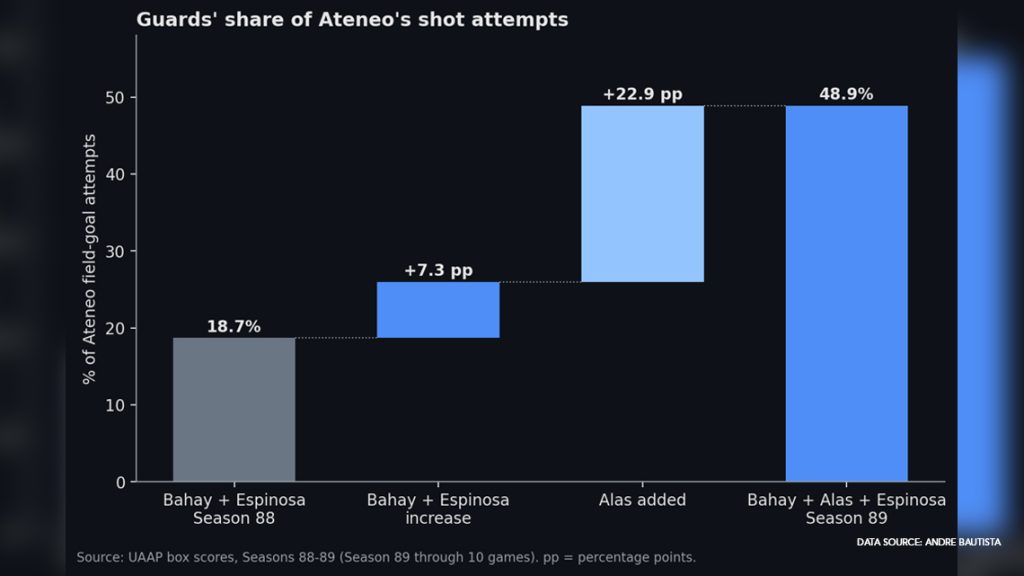
At first glance, the difference looks huge. Last season, Bahay and Espinosa took 18.7% of Ateneo’s shots. This season, Bahay, Kieffer, and Espinosa account for 48.9%. But Kieffer alone takes 22.9% of the team’s shots, meaning so much of that increase comes from having another player in the group. Looking only at Bahay and Espinosa, their share has gone from 18.7% to 26%.
Their roles have also changed in different ways.
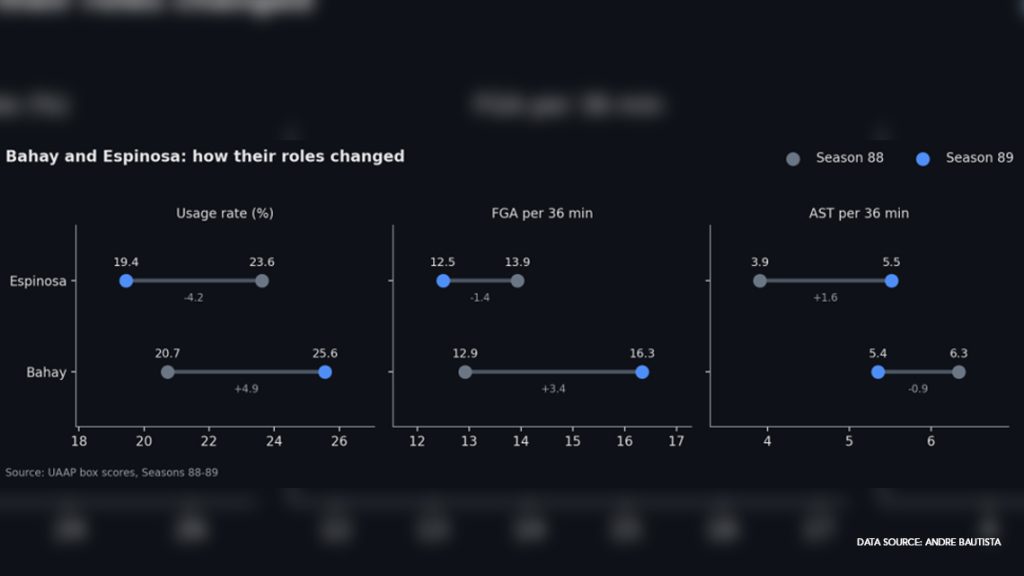
To compare their roles more fairly, the numbers below are adjusted to a per-36-minute rate. Both guards are playing more minutes than they did last season, with Bahay going from 22.7 to 25.6 minutes per game and Espinosa from 15.1 to 19.6. More playing time naturally means more opportunities to put up shots and rack up assists. By scaling their production to 36 minutes, we can better assess what each player brings to the table regardless of how much time they spend on the floor. This also serves as a common benchmark for a starter’s workload.
Bahay’s usage rate increased from 20.7% to 25.6%, while his shot attempts per 36 minutes rose from 12.9 to 16.3. His assists per 36 minutes, however, dropped from 6.3 to 5.4.
Espinosa has gone in the opposite direction. His usage rate fell from 23.6% to 19.4%, and his shot attempts per 36 minutes dropped from 13.9 to 12.5. At the same time, his assists per 36 minutes increased from 3.9 to 5.5. Simply put, Bahay has taken on more scoring responsibility, while Espinosa has become more focused on setting up his teammates.
Bahay explained that one of the biggest differences comes from who decides which plays to run.
“Kay Coach Tab kasi dati, sa kanya nanggagaling kung ano yung tatakbo namin. Kay Coach Louie, sa guards mismo kung ano yung gusto naming takbuhin.”
That increased freedom is also reflected in how Ateneo runs its offense. The Blue Eagles are playing at a faster pace, averaging 78 possessions per 40 minutes, the second-highest mark in the UAAP, compared to 73.4 last season, which was the second-lowest. With a more experienced Bahay and Espinosa, alongside Kieffer now leading the way, Ateneo has the personnel to play at a much faster pace.
Another difference is how Ateneo creates its shots. Only 45.1% of the team’s made field goals have come off assists this season, down from 57.7% last year. This suggests that the Blue Eagles are relying more on individual shot creation rather than assisted baskets.
The offense has improved, too. Ateneo now scores 97.2 points per 100 possessions, up from 93.5 last season. Its defense, however, has slipped from 95.7 to 98.9 points allowed per 100 possessions.
If Escobar Counts as a Guard
For this comparison, Dom Escobar, who played for Ateneo in Season 88, is classified as a forward. However, his playstyle makes a case for including him among the guards. While his 9.4 rebounds per 36 minutes point to a more frontcourt-oriented role, Escobar was also heavily involved in Ateneo’s offense. He averaged 26.7 minutes per game and 3.6 assists per 36 minutes, while posting a 21.6% usage rate—right between Bahay’s 20.7% and Espinosa’s 23.6%.
If Escobar is counted as a guard, last season’s group accounted for 30.1% of the team’s minutes, 32.6% of its shot attempts, and 49.1% of its assists. The increase this season would be smaller, at 6.8, 16.2, and 15.9 percentage points, respectively. Still, the overall trend remains the same.
The Responsibility
When asked if the freedom Coach Louie gives his guards works to their advantage, Bahay explained that he does not see it as a benefit, but as part of their responsibility.
“Hindi naman siya benefit. Wala naman siya kasi papatakbuhin pa rin namin yung team namin. Kailangan pa rin ma-get everybody involved, and yun naman talaga yung priority sa amin na guards.”
The numbers show that the guards are fulfilling their role in doing just that. Of the 81 field-goal assists Bahay, Kieffer, and Espinosa have recorded in the play-by-play data this season, 61 have gone to teammates outside the guard group. (Box-score assist totals, used elsewhere in this article, also include assists credited on free throws, so they run higher. The three guards have 91 in the box score.)
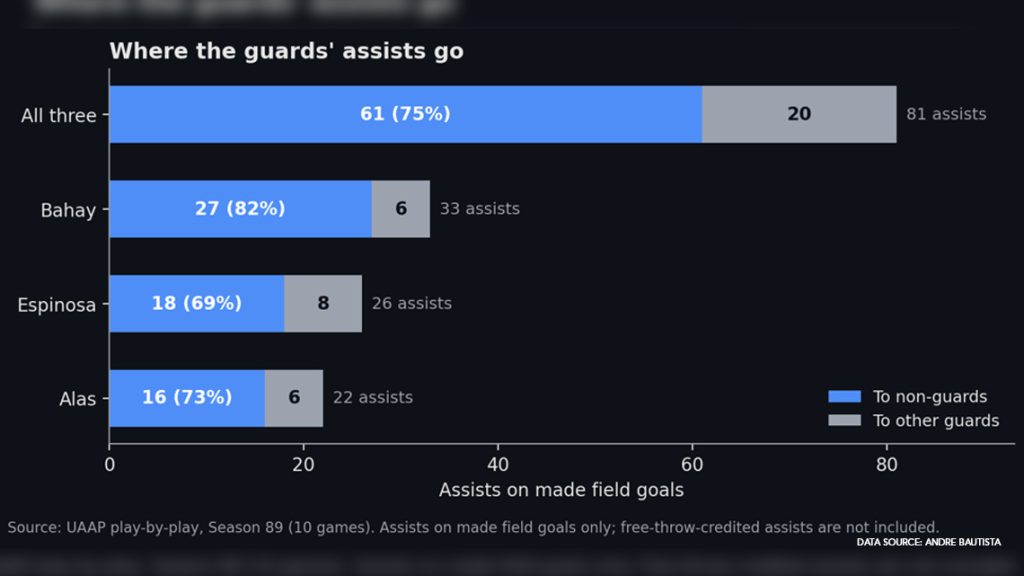
That split makes sense given how Ateneo scores. Players outside the guard group account for slightly more than half of the team’s made baskets, and a larger share of their field goals come off an assist. About a third of the guards’ made field goals come off an assist, compared with more than half for the rest of the team. Among the three guards, Bahay directs the largest share of his assists to non-guards, with 27 of his 33 (82%) leading to baskets by players outside the group. Kieffer follows with 16 of 22 (73%), while Espinosa has 18 of 26 (69%).
Their teammates have benefited from this playmaking. Travis Roberts has had 61% of his made field goals assisted, and 13 of his 19 assisted baskets came from the guards. EJ Kapihe sits at 67%, with the guards also setting up 10 of his 14 assisted baskets.
But creating opportunities for others is only one part of the job. The guards must also make the most of their own chances.
As a group, Bahay, Kieffer, and Espinosa have a combined true shooting percentage of 47%, below the 49% posted by the rest of the roster. The gap may seem small, but at the rest of the roster’s efficiency, the guards’ shots would have produced about 1.6 more points per game. That matters for a team whose last three games were all decided by four points or fewer.
Part of the difference could be explained by the shots they take. Only 32.6% of the guards’ made field goals have been assisted, compared to 56.2% for the rest of the team. This suggests that the guards often have to create their own shots rather than finish opportunities created by others.
Taking care of the ball, meanwhile, has not been a major problem. The guards turn the ball over on 13.3% of the possessions they use, compared to 15.9% for their teammates. Bahay’s turnover rate has also remained almost the same, moving from 14.7% to 14.4%, even as his usage rate has increased by nearly five percentage points.
The bigger concern lies in the difference between the guards themselves. Bahay has a 53.6% true shooting percentage, while Kieffer sits at 44.2% and Espinosa at 42.1%. With the offense running through the guards, their efficiency carries added importance. And with Kieffer leading the group in usage rate, his shot selection and ability to convert opportunities become especially crucial.
This is the responsibility that comes with the trust Bahay described. When a coach allows his guards to decide how to run the offense, they also have to take responsibility for the results of those decisions.
Ateneo currently holds a 5–5 record, trailing La Salle (6–4) and FEU (5–4) in the race for a Final Four spot. Close behind are Adamson (4–5) and UST (4–6), keeping the Blue Eagles in a tight race following their overtime loss to the Green Archers. Asked about the team’s mindset moving forward, Bahay kept it simple.
“Tiwala lang sa isa’t isa lang, puso lang.”
Ateneo’s guards have shown they can run the offense and create for their teammates. Now, as the Final Four race tightens, the challenge is to turn that trust into consistent results.