
Why UP’s AUBL Trip to China Is Bigger Than One Tournament
When the UP Fighting Maroons arrive in Hangzhou this August, they will bring more than a roster, a coaching staff, and the weight of one of the Philippines’ most followed college basketball programs. They will bring a market.
That is the real treasure behind UP’s entry into the Asian University Basketball League. On the surface, it is a basketball invitation: one Philippine school joining an international tournament against university teams from Japan, Korea, Chinese Taipei, Mongolia, China, Hong Kong, and Australia. Underneath it, however, is something more ambitious.
The AUBL is trying to prove that Asian college basketball can become a regional sports property, one that sits at the intersection of player development, education, media, fan culture, and investment.
The league’s imminent tournament, set for August 2 to 9, is not being built as a simple preseason stop. It is being positioned as a showcase for what Asian university basketball could become if organized across borders with the right schools, the right backers, and the right storylines.

For the Philippines, UP is the first test case.
“The Philippines has one of the richest basketball cultures anywhere in the world,” AUBL founder and CEO Jay Li said in an exclusive interview with ALL-STAR Magazine. “For the AUBL, it was important that the league capture that passion and energy.”
The Fighting Maroons are entering a league that sees the Philippines as a basketball market with unusual energy, emotional investment, and international potential. Filipino fans do not need to be taught how to care about basketball. They just do. The question for AUBL is whether that passion can travel into a regional college competition.
UP will be part of a 12-team field that includes Hakuoh University and Waseda University from Japan, Korea University and Yonsei University from Korea, National Chengchi University from Chinese Taipei, the National University of Mongolia, Peking University, Shanghai Jiao Tong University, The Chinese University of Hong Kong, Tsinghua University, and the University of Sydney. It is a lineup designed not only for competition, but for geography. Each school brings a market. Each market brings a different basketball culture.
That is where the AUBL’s ambition becomes clearer.
This is not just about finding out whether UP can beat a bigger Chinese team, a disciplined Japanese team, or a physical Korean team. It is about whether these schools can become recurring characters in a larger Asian basketball story. It is about whether Tsinghua versus UP, Yonsei versus Waseda, National Chengchi versus Korea University, or Sydney versus Peking can eventually mean something to fans beyond the campuses involved.
In the United States, college basketball became powerful because it connected school identity, player development, television, alumni, rivalries, and professional dreams. Asia does not have to copy that model exactly, and in many places it cannot. The school systems are different, the sports calendars are different, and the role of education in family decision-making is different. But the AUBL is betting that Asian university basketball has its own version of that formula.
Li describes AUBL as “a platform catering to a global audience” and said the league hopes to become “Asia’s feeder system for the international professional basketball ecosystem.” The AUBL does not want to be remembered as a summer tournament. It wants to sit somewhere between college competition, player pathway, and regional sports entertainment property.

The investors around the league make that ambition harder to dismiss.
AUBL has drawn backing from figures and groups with deep ties to basketball, sports ownership, and global capital, including Joe Tsai’s Blue Pool Capital, Marc Lasry’s Avenue Capital Group, David Blitzer’s Bolt Ventures, and Chinese basketball legend Yao Ming.
Li said the people behind the league share a belief that one of the most exciting areas of Asian basketball sits at the college level. The reason is not hard to understand. Universities carry history. They carry alumni networks. They carry national and local identity. In Asia, they also carry enormous social credibility because families place deep value on education. A league that can combine that credibility with serious basketball could become something rare.

“AUBL represents a remarkable business opportunity,” Li said.
For UP, that business opportunity is tied to something more emotional. The Fighting Maroons are one of the clearest examples in the Philippines of how college basketball can become bigger than the games themselves. UP’s rise over the past several years turned the program into a national conversation, not just a campus story. The team’s following stretches across students, alumni, casual fans, former players, sponsors, and supporters who have watched the program grow into a consistent contender. Whether they like to admit it or not, the haters tune in as well.
That is the kind of profile AUBL wants. It does not only need strong teams. It needs schools that make people care.
Greg Stolt, AUBL’s senior vice president, said the league looks at a broad set of factors when evaluating teams. Competition matters, but so do academic strength, market representation, fan relevance, and the ability to fit into a bigger regional plan.
“I really think it’s all of the above,” Stolt said. “Ideally, we want the most competitive, well-rounded, best academic program, and best representative from each market to participate.”

Stolt said AUBL is excited to see UP compete and to better understand the Philippine game.
“This year, we can’t be more excited about having UP participate,” he added. “It’s going to be a lot of fun watching them, getting to know and understand the game from the Philippines a little bit better, and see them compete at the highest level.”
UP is used to the speed, emotion, and pressure of the UAAP, but the AUBL will present different problems. The Maroons could see more size than they usually face. They could see offensive systems they do not regularly prepare for. They could face opponents who play with different spacing, timing, physicality, and tempo.
Stolt pointed to that variety as one of the league’s competitive strengths.
“Whether it’s size, speed, skill sets, strategy, I think the opportunity for UP to play against the teams in their pool is going to be new for them because it’s something that’s a little bit different than domestically, the UAAP or the NCAA in the Philippines,” he said.
That spread is exactly what Stolt believes can raise the level of the region.
“The AUBL is a platform or an opportunity for teams to compete against very high-level competition that they may not be able to compete at in their domestic leagues,” he said. “Whether it’s teams playing each other, coaches coaching against each other, or players playing against each other, with this, it’s just another opportunity for players to see high-level competition on a regular basis.”

The league has spoken about building toward a home-and-away structure, which would be a much larger challenge.
Travel, calendars, academic obligations, sponsorship, broadcasting, competitive balance, and university cooperation all become more complicated once the event becomes a league.
Li does not pretend the build will be easy.
“I think it’s all of these things,” he said when asked about the hardest part of building a sustainable regional property. “Creating something new is always challenging, but that’s also what makes my job so much fun.”
The league has enough ambition to attract attention, enough capital to be taken seriously, and enough basketball logic to make sense. But it still has to prove that the model can hold. Can teams commit year after year? Can fans follow opponents from other countries? Can broadcasts create familiarity? Can sponsors see value beyond a one-time event? Can a university basketball league in Asia become part of the regular basketball calendar?
UP’s arrival will help answer some of those questions. Filipino basketball fans are among the most active and vocal in the region. If they engage with the AUBL, they can immediately give the league a different kind of visibility. We’ve seen it with the Japan B. League and KBL. A strong UP showing would help, but the larger win for the AUBL would be making Filipino fans care about the competition itself, not just the Maroons’ record.
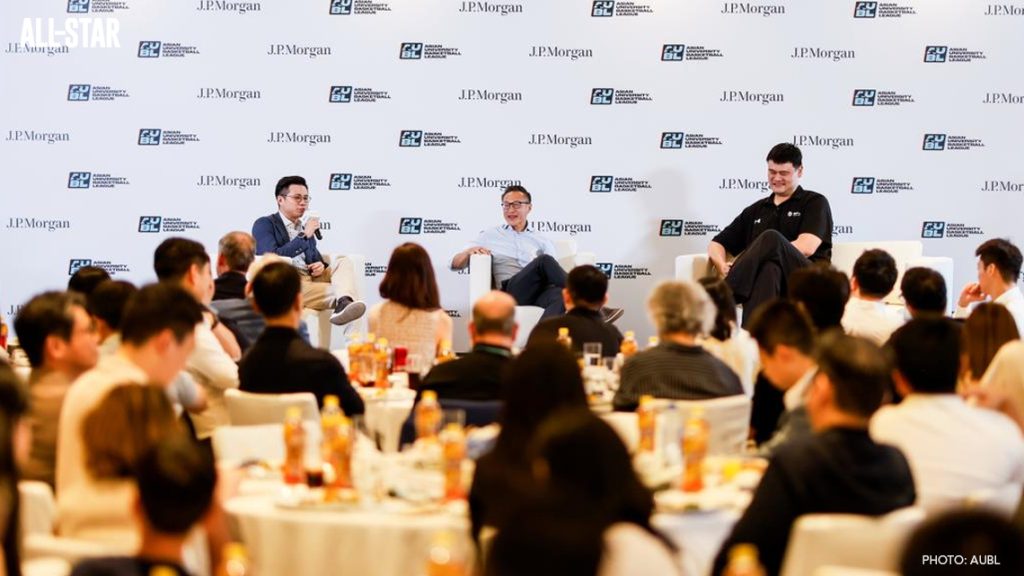
That is why Stolt said a successful UP debut is not limited to wins and losses.
“It’s the first team from the Philippines to join the AUBL, and we’re certain they’re going to represent the Philippines and UAAP and basketball in the Philippines in the right way,” he said. “I’m really excited to see their style of play and then compete against different teams from throughout the region.”
UP will not only represent Diliman. It will represent the UAAP, Philippine college basketball, and the country’s belief that its players can compete outside their domestic comfort zone.
That creates pressure, but also opportunity. UP’s players will get film against teams they rarely see – and maybe some scouts to look at them for international opportunities. Its coaches will get new scouting problems. Its supporters will get a new stage. And the program will get a chance to attach itself early to a league that wants to grow into something much bigger.
Li’s vision for AUBL extends beyond competition. He has spent years around major basketball institutions, from the NBA to the Chinese Basketball Association to projects connected with Yao and Tsai. His view of the league is shaped by that journey, but not limited to it. He does not describe AUBL as a copy of March Madness, the NBA, or any existing model. He frames it as something built from the Asian basketball landscape itself.
“I hope AUBL will become something bigger than just basketball,” Li said, “a true pop culture movement that represents the spirit and energy of Asia’s next generation.”
The Maroons will be trying to win games. The league will be trying to win belief.
If the AUBL is right about where the next opportunity lies, the Fighting Maroons will not just be joining the field. They will be helping define the market.