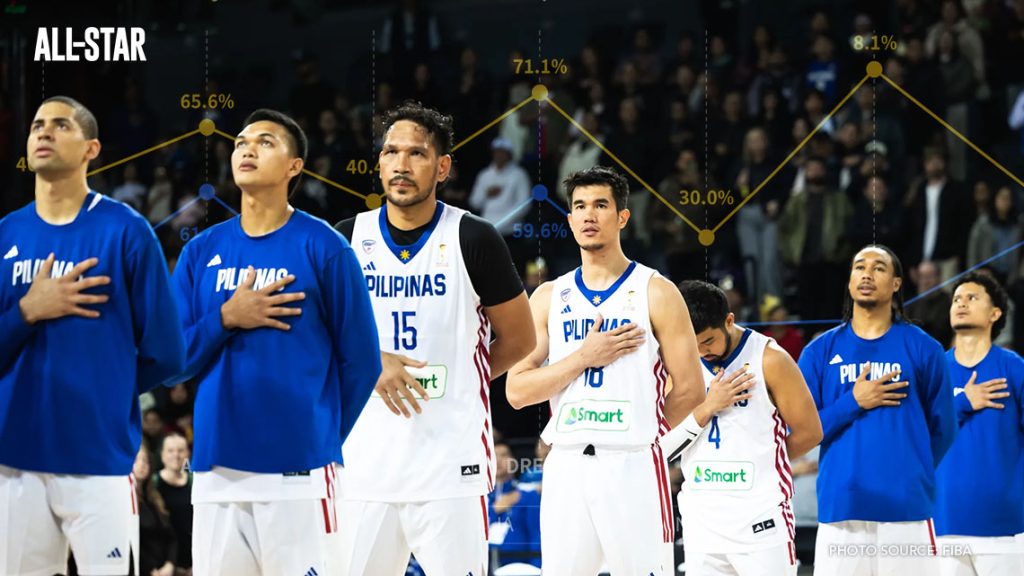
A Data-Driven Look at Hope and Reality for Gilas Pilipinas
In a game where the hopes of an entire nation rested on Gilas Pilipinas, the final buzzer brought heartbreak—not because they weren’t good enough, but because they came agonizingly close to delivering one of the greatest victories in Philippine basketball history.
The national team fell to New Zealand in a double-overtime thriller, 102–106, in a performance that had the country cheering, believing, and then ultimately, grieving.
For 50 minutes, Gilas proved it could stand toe-to-toe with the FIBA world No. 24 New Zealand Tall Blacks—only to see the opportunity slip away.
Three days later, that heartbreak gave way to a reality check. Against Australia, one of the world’s top basketball programs, Gilas suffered a 43-point defeat, falling 49–92—a stark reminder of how far the gap still stretches between the national team and the sport’s true heavyweights.
But beyond the emotional roller coaster of both results lies another story—this one just happens to be written in numbers.
The Pregame Context
Before their July 3 clash with New Zealand, Gilas Pilipinas carried the second-best Net Rating in Group A at +11.3. The foundation of that success was its defense, with Gilas leading the group in Defensive Rating by allowing an estimated 90 points per 100 possessions.
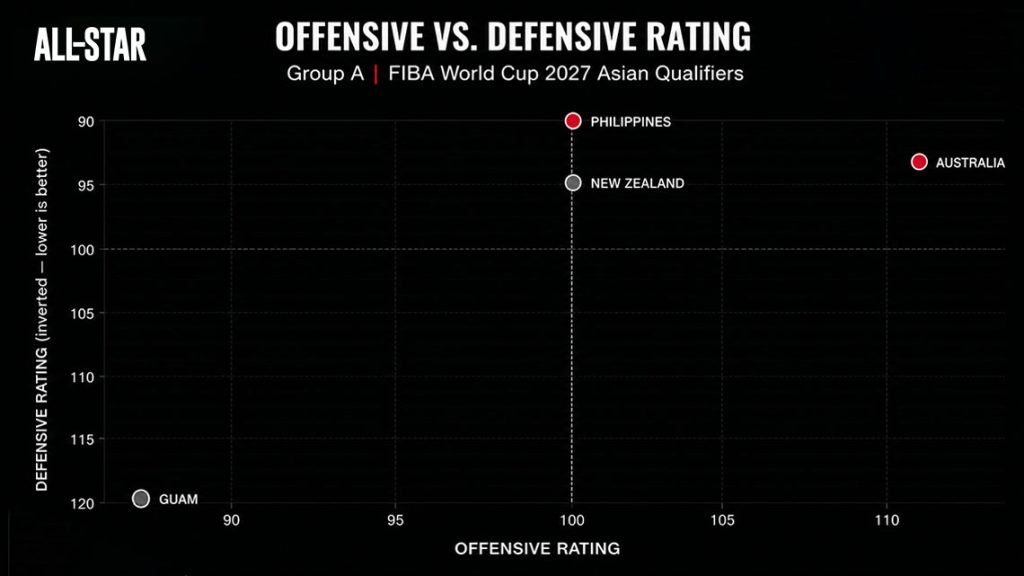
There’s another layer to those numbers, however. New Zealand’s schedule had been considerably tougher, with two games against Australia and one against Guam, while Gilas had faced Australia once and Guam twice. As a result, the raw metrics naturally painted a more favorable picture for the Philippines.But perhaps the most revealing aspect of the graph is how little separates Gilas Pilipinas and New Zealand—a margin that proved just as slim on the court.
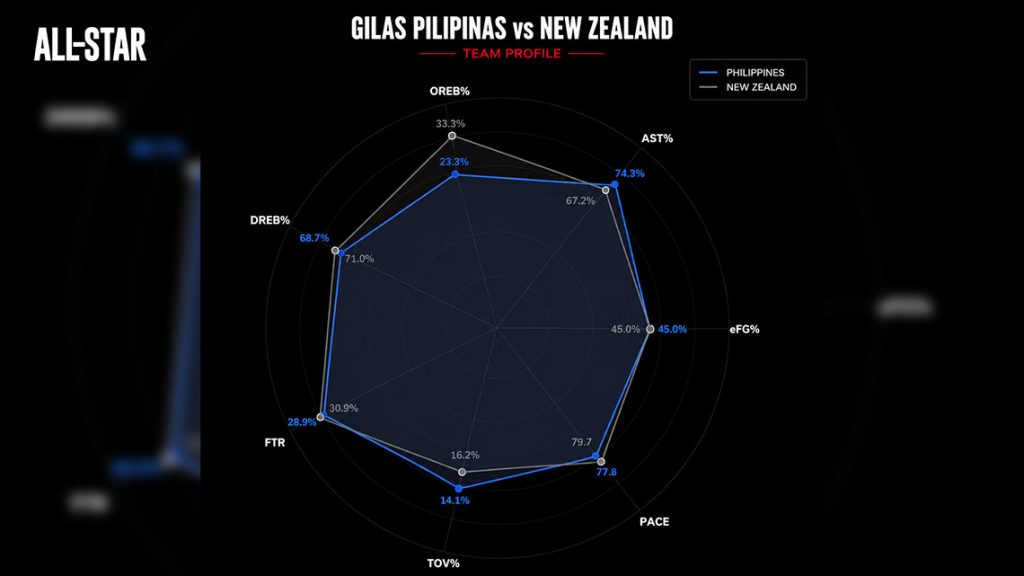
As the graph illustrates, both teams share remarkably similar statistical profiles, playing at nearly the same pace and with the same level of efficiency. Yet beneath those similarities lie two very different paths to success.
New Zealand held the edge on the glass, particularly in offensive rebounding, and turned those extra possessions into more trips to the free-throw line, finishing with the higher Free Throw Rate. Gilas Pilipinas, meanwhile, found its advantage elsewhere—prioritizing ball movement and ball security, as reflected in its edge in Assist Percentage (AST%) and Turnover Percentage (TOV%).
Their first meeting in February offered a glimpse of those contrasting identities.
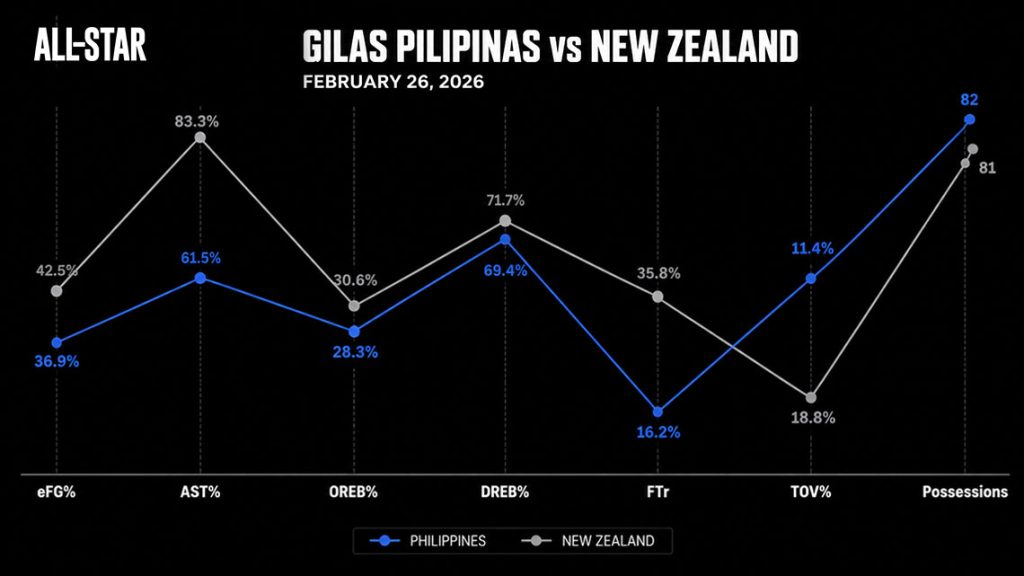
Although both teams played at almost the same pace, New Zealand made far better use of its possessions. The Tall Blacks posted a higher effective field goal percentage (eFG%), reversed Gilas’ usual edge in playmaking by finishing with a higher AST%, and controlled both the offensive and defensive glass while also getting to the free-throw line more often.
Gilas’ lone statistical edge came in taking care of the basketball while forcing New Zealand into more turnovers. More importantly, they capitalized on those mistakes, scoring 20 points off turnovers—a key reason they stayed within striking distance despite being outmatched in other areas.
Despite that, Gilas fell short, 66–69. The difference may have been that the national team was unable to play to its statistical strengths. Let’s see how that changed in the rematch.
A Battle We Will Never Forget
In a contest that featured 14 lead changes and 13 ties, it delivered everything basketball fans could ask for.
It was a game that kept fans on the edge of their seats, with victory seemingly always within Gilas Pilipinas’ reach. And if the numbers are any indication, it almost was.
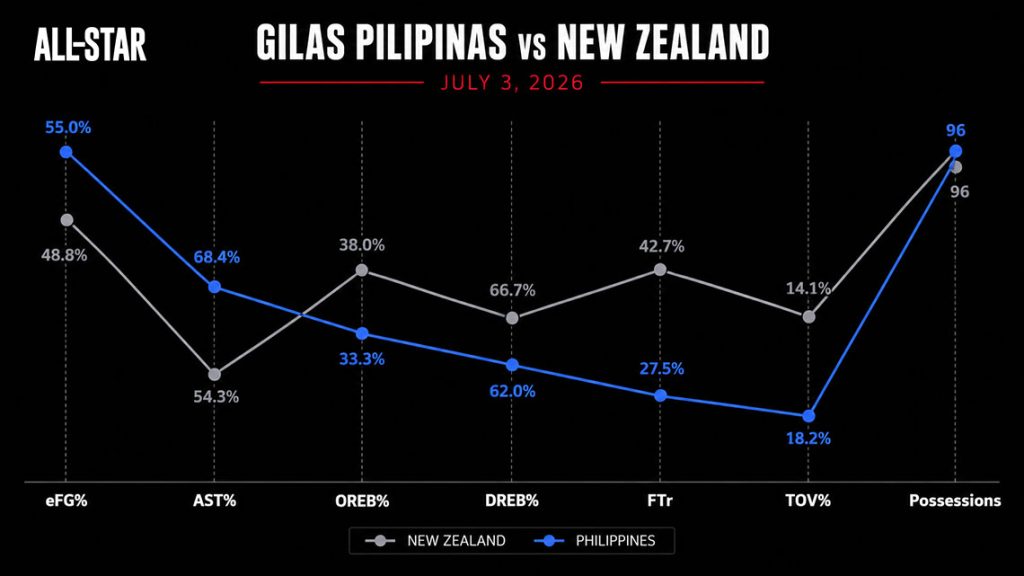
This time, the national team found its offensive edge. Leading in eFG% through more efficient shooting inside and beyond the arc, Gilas also moved the ball better—setting the stage for several players to catch fire.
Who are those players? Well, these guys right here:
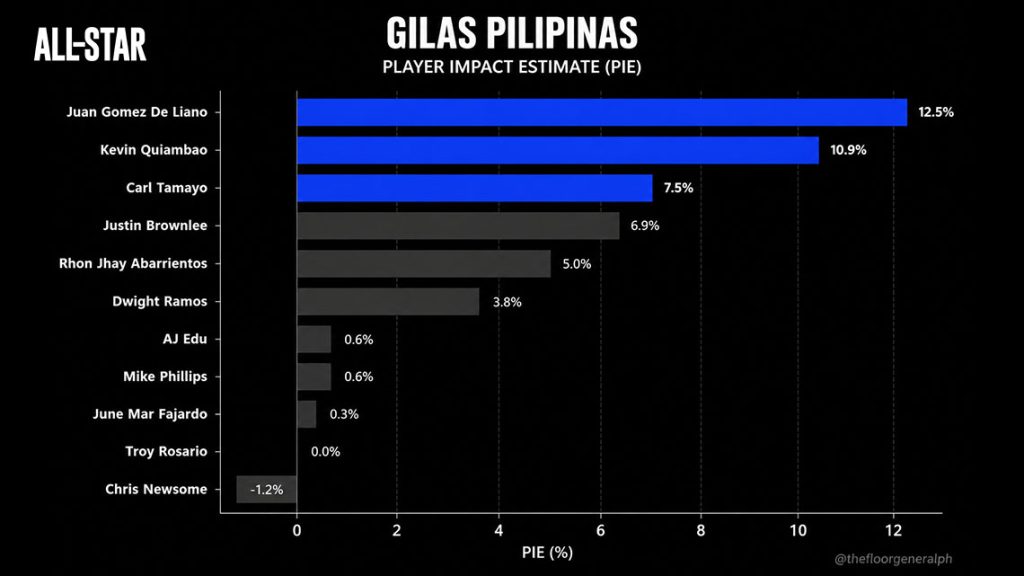
When Gilas needed answers, these three provided them. According to Player Impact Estimate (PIE), a metric that measures a player’s overall impact, Juan Gomez de Liaño, Kevin Quiambao, and Carl Tamayo combined for a remarkable 31% PIE—nearly one-third of everything that happened in the game—for both teams.
If you watched the game, there was little room for debate. The numbers simply confirmed what the eye test had already told us.
While Gilas was down most of the game, this trio is what made them stay afloat.
Gomez De Liaño played with poise and confidence. Quiambao seemed to hit from everywhere. And Tamayo showed that he’s ready to take the leap as Gilas Pilipinas’ next great forward. It felt like we were watching the future of Gilas Pilipinas unfold in real time.
The trio shouldered much of the offensive load, combining for 63 of Gilas Pilipinas’ 102 points while leading scorer Justin Brownlee endured an uncharacteristically quiet night. Yet Brownlee’s impact extended far beyond the scoring column. He still posted a 6.9% PIE, fueled by his relentless work on the glass with eight rebounds, along with three steals and a block that underscored his two-way value.
RJ Abarrientos also left his mark, posting a 5% PIE, driven largely by his 10 assists that kept Gilas’ offense humming. Dwight Ramos, meanwhile, once again proved to be the steady veteran the national team could rely on. He finished with a 3.8% PIE and chipped in 18 points as Gilas’ third-leading scorer.
However, despite these performances, New Zealand found its edge by staying true to its identity—crashing the boards, getting stops on the defensive end, and forcing turnovers, all fueled by their relentless physicality.
Ramos identified that as the key difference during the postgame press conference.
“They’re so physical pressuring the ball, and it makes it really hard for us to get into the offense. Obviously, the rebounding is tough, and I think that’s what they pride themselves on,” the 6-foot-3 swingman said.
New Zealand controlled the glass from start to finish, posting a 38.0% offensive rebounding rate (OREB%) compared to Gilas’ 33.3%, while also grabbing 66.7% of available defensive rebounds (DREB%) to Gilas’ 62.0%.
That relentless effort earned the Tall Blacks more trips to the free-throw line, finishing with a Free Throw Rate (FTr) of 42.7 compared to Gilas’ 27.5. Their physicality also disrupted Gilas’ offense, forcing the national team into an 18.2 TOV%—well above its tournament average of 14.1%—before converting those extra possessions into 25 points off turnovers.
From the moment Gilas took its first lead, 70–68, with 6:54 remaining in the fourth quarter, it felt like the momentum had finally shifted in their favor. That feeling only grew stronger moments later when Quiambao and Ramos knocked down back-to-back three-pointers to stretch the lead to 77–70, with Ramos’ triple taking a fortunate bounce off the rim—as if, for just a moment, destiny was on Gilas’ side.
However, despite every attempt by Gilas to pull away, New Zealand answered with the poise and physicality that defined its night—a corner three, a turnover converted into a fast-break dunk, and trips to the free-throw line quickly brought the Tall Blacks back into the game.
After Tai Webster scored on back-to-back paint touches, the defining moment of New Zealand’s run came with 24.7 seconds remaining. The Tall Blacks forced a costly turnover from Brownlee, leading to a possession that resulted in two free throws, putting the Tall Blacks in a position to win the game, 80-83.
However, Gomez de Liaño, continuing his microwave-hot performance, delayed what seemed inevitable by knocking down a clutch three to force overtime.
A Bloody Overtime Thriller
When the final buzzer sounded at the end of regulation, the game shifted into overtime—and the battle only intensified.
Every possession became a high-stakes exchange, with neither team willing to give an inch. The back-and-forth action kept everyone on edge, as each trip down the floor carried the potential to decide the outcome.
New Zealand landed the first punch, but Gilas Pilipinas responded at every turn as the lead changed hands repeatedly. Neither side could create any separation, with every basket immediately met by an answer from the other. Then came the defining sequence of the period.
Trailing by one with just seconds remaining, Abarrientos found Gomez De Liaño as he calmly knocked down another clutch three-pointer to put Gilas ahead by two with 8.3 seconds left. Just when it looked like the Filipinos had seized control, New Zealand answered on the ensuing possession to force a second overtime, extending an already unforgettable battle.
However, this is where things took a turn for good.
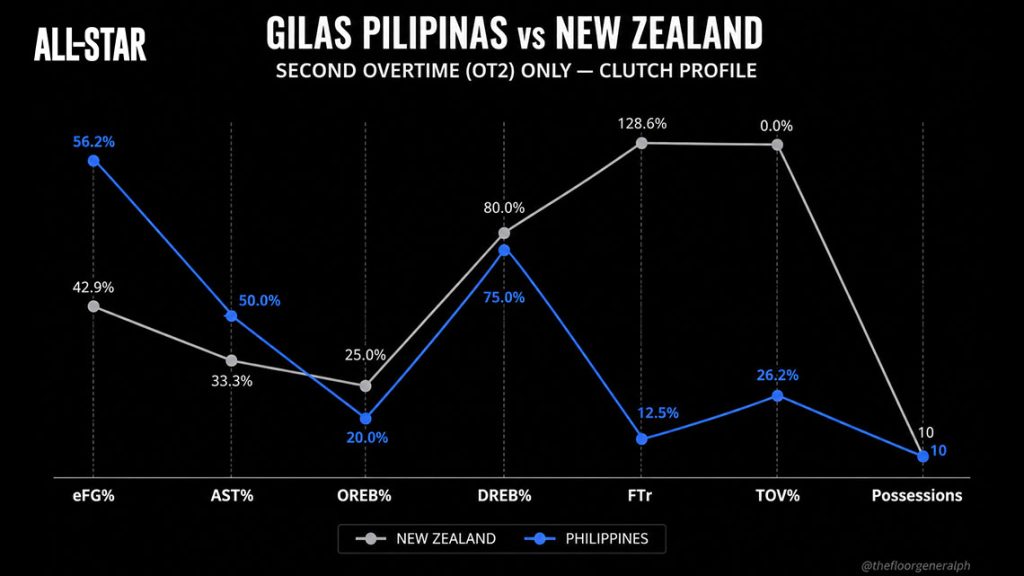
If the first overtime was defined by a clutch three, the second was won through composure. New Zealand reclaimed the lead early, but Gilas continued to produce timely scoring bursts, briefly regaining the advantage behind Gomez de Liaño and AJ Edu. The Filipinos remained highly efficient offensively, posting a 56.2 eFG% and a 50 AST% in the second overtime, showing they could still generate quality looks despite the pressure.
The difference, however, came in everything between those baskets. While Gilas unraveled with a costly 26.2% turnover rate, New Zealand slowly tightened its grip on the game by protecting the ball and relentlessly attacking the paint, resulting in an astronomical 128.6 FTr (the Tall Blacks shot more free-throws than field goals attempted, explaining why the Free Throw Rate was very high).
Rather than relying on explosive runs, the Tall Blacks patiently accumulated points at the stripe, turning every Gilas mistake into another opportunity to extend the game on their terms. As the final minutes unfolded, New Zealand’s discipline overwhelmed the Philippines’ shot-making, calmly closing the game from the free-throw line to secure the victory.
In the end, the double-overtime thriller became a tale of two contrasting identities: Gilas survived on explosive offensive outbursts, while New Zealand prevailed through patience, possession control, and relentless pressure—proof that in clutch basketball, consistency can be just as decisive as brilliance.
What Went Wrong
This is by no means an attempt to pin the loss on Justin Brownlee. Time and again, he has been Gilas Pilipinas’ best player on the biggest stage. But this was one of the rare nights where the four-time PBA Best Import wasn’t at his usual standard. Much like their meeting in February—if not more so—Gilas needed Brownlee to be at his best.
For a player who has been Gilas Pilipinas’ primary scoring option, three field-goal attempts simply aren’t enough. New Zealand deserves credit for the way they defended Brownlee, but there also seemed to be too few opportunities to free him for quality looks. Whether it was Brownlee’s ability to create separation or the team’s efforts to get him to his spots, Gilas never consistently found ways to put the ball in his hands as a scorer.
Second was the decision to lean on Abarrientos over Juan Gomez de Liaño during the first overtime. This is not to diminish Abarrientos’ impact—his playmaking remained valuable throughout the game—but his shot simply wasn’t falling, while Gomez de Liano had the hot hand.
If the priority was to have another playmaker on the floor, the gamble ultimately didn’t produce the offensive breakthrough Gilas needed. Gomez de Liaño, meanwhile, was enjoying his best game of his national team career, posting a remarkable 74.5% True Shooting percentage. He poured in 23 points on just 15 field-goal attempts, shooting 60% from the field, 44.4% from beyond the arc, and a perfect 1-for-1 from the free-throw line. Riding the hot hand may not have guaranteed a different outcome, but it could have increased Gilas’ chances of finding the basket when it mattered most.
Lastly—and perhaps most importantly—was the absence of Kai Sotto. Against a team as physical as New Zealand, his presence was sorely missed.
The last time Kai Sotto wore the Gilas Pilipinas jersey, he was dominant. During the FIBA Asia Cup 2025 Qualifiers, the 7-foot-3 center averaged 15.5 points, 12.5 rebounds, and 2.3 blocks per game.
One of those games came against New Zealand—the same opponent Gilas faced this time—but the outcome was different. Gilas came away with the victory.
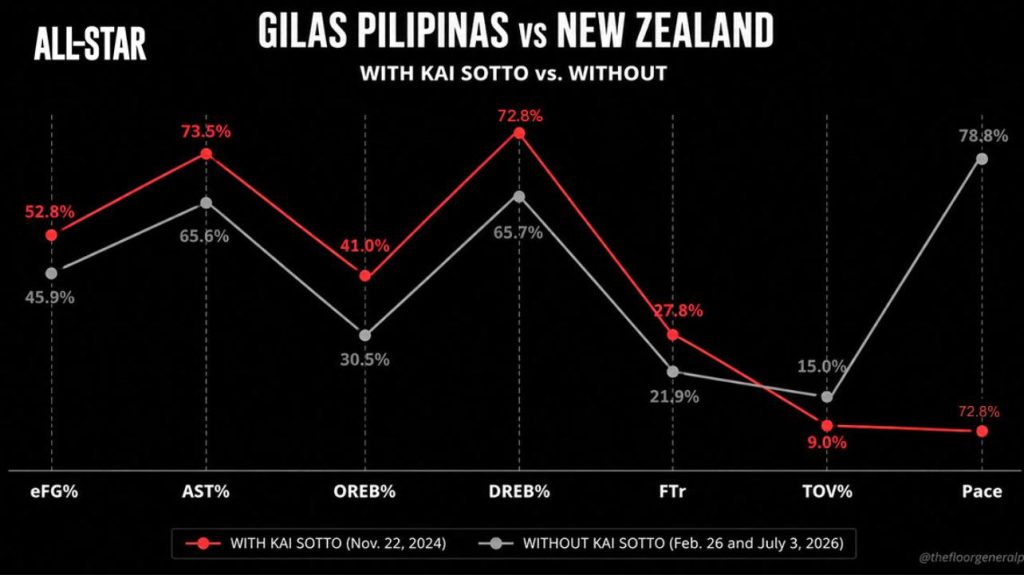
As the numbers show, Gilas performed markedly better across nearly every key metric with Kai Sotto in the lineup than it did in its two meetings with New Zealand this year.
The contrast was especially evident inside the paint. Across their two matchups this year, New Zealand averaged 39 paint points per game to Gilas’ 32. In the game Sotto played, however, Gilas dominated that battle, outscoring the Tall Blacks 48–16 in the paint. After all, having a 7-foot-3 presence down low is a difference no team can easily replace.
In the end, the numbers did more than explain why Gilas lost to New Zealand—they also showed how close the national team is to breaking through. Against one of Asia-Oceania’s finest, the margins came down to execution, composure, and a handful of possessions. It may end up as another loss in the standings, but the performance suggested something far more important: Gilas Pilipinas is closer than ever. The question was whether that same resilience would hold up just three days later, against an opponent in a class of its own.
Reality Check Against the Boomers
The outlook was far less encouraging against Australia. Revisiting the earlier statistical snapshot of Group A, while Gilas Pilipinas appeared to be on relatively even footing with New Zealand, the gap between the national team and the Boomers was impossible to ignore. And the numbers translated directly to the scoreboard.
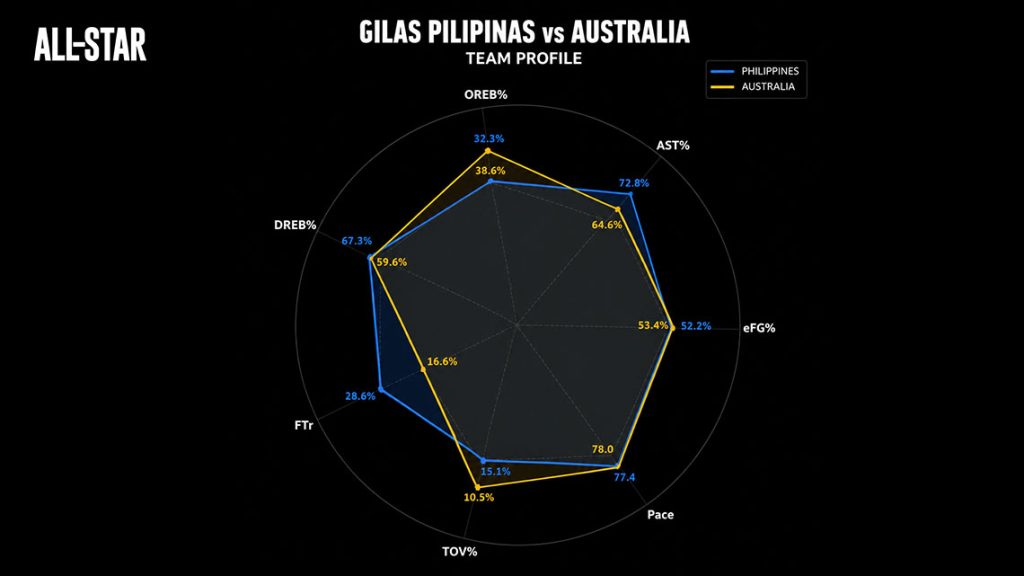
Prior to their fateful July 6 matchup, the statistical profiles of both teams painted a clear picture of the challenge facing Gilas Pilipinas.
By virtually every major metric, Australia held the upper hand. The Boomers were more efficient offensively, stronger on the glass, more disciplined in taking care of the ball, and less reliant on free throws to generate points. Gilas’ lone edge came in playmaking, where it posted a slightly higher AST%.
However, the gap seemed much larger than that. In stark contrast to the tightly contested battles against New Zealand, Gilas suffered a 43-point defeat to Australia.
A major factor was the absence of Justin Brownlee, who was sidelined through injury. Without their primary offensive engine, the Filipinos struggled to generate the same level of shot creation, scoring punch, and overall offensive stability.
To better understand the difference, let’s look back at how Gilas performed against Australia in their March 1 meeting.
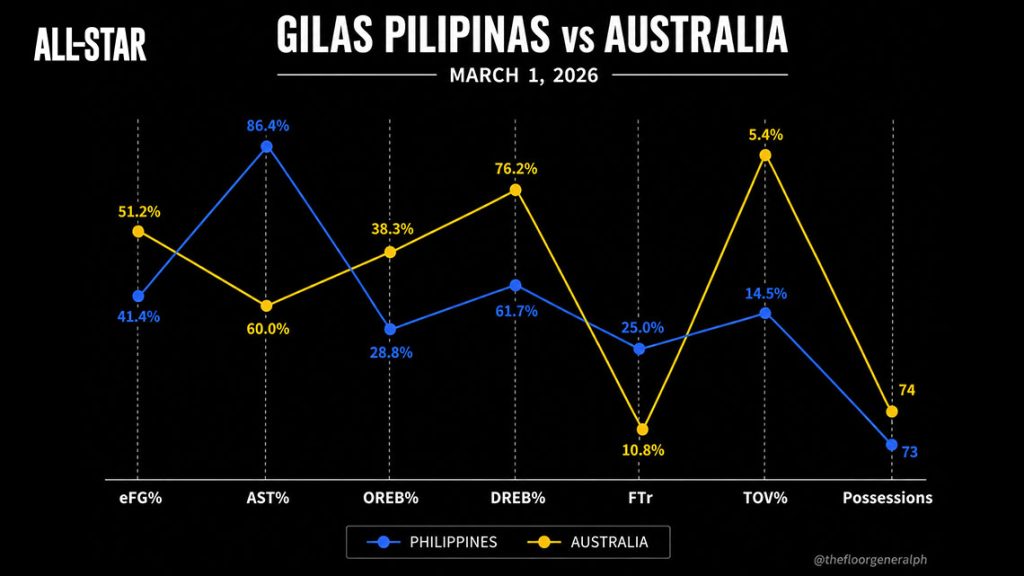
While the result was still far from encouraging—a 66–93 defeat and a 27-point margin—the game did reflect one aspect of the statistical profile. As expected, Gilas was able to hold its own in terms of playmaking and ball movement. Unfortunately, against a team of Australia’s caliber, that alone was never going to be enough.
The outcome was much more respectable with Brownlee on the floor.
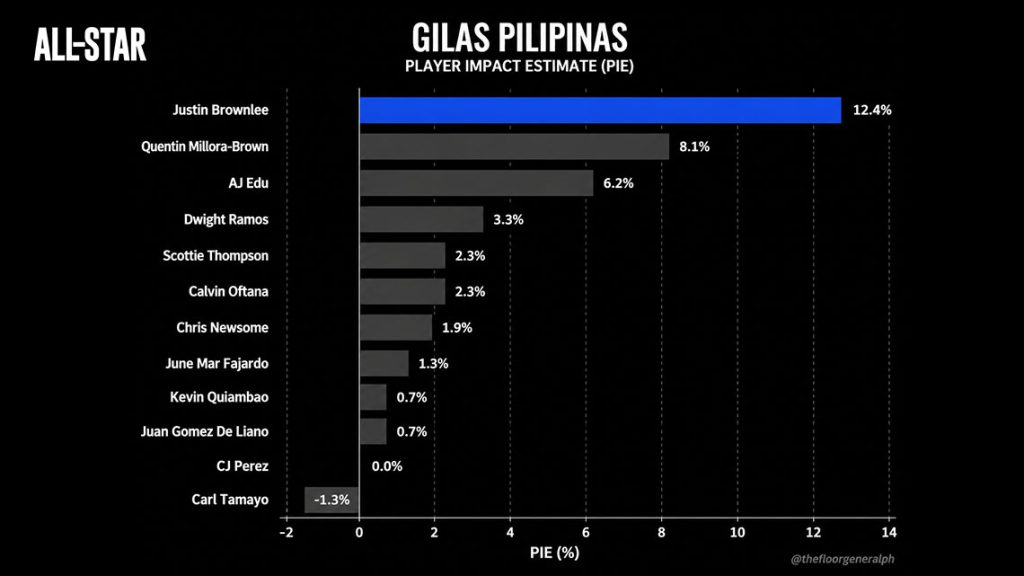
In that game, Brownlee delivered an all-around performance with 20 points, eight rebounds, and seven assists. His impact was reflected in his PIE rating, where he accounted for 12.4% of the game’s total output.
However, this is what happened without him on the court:
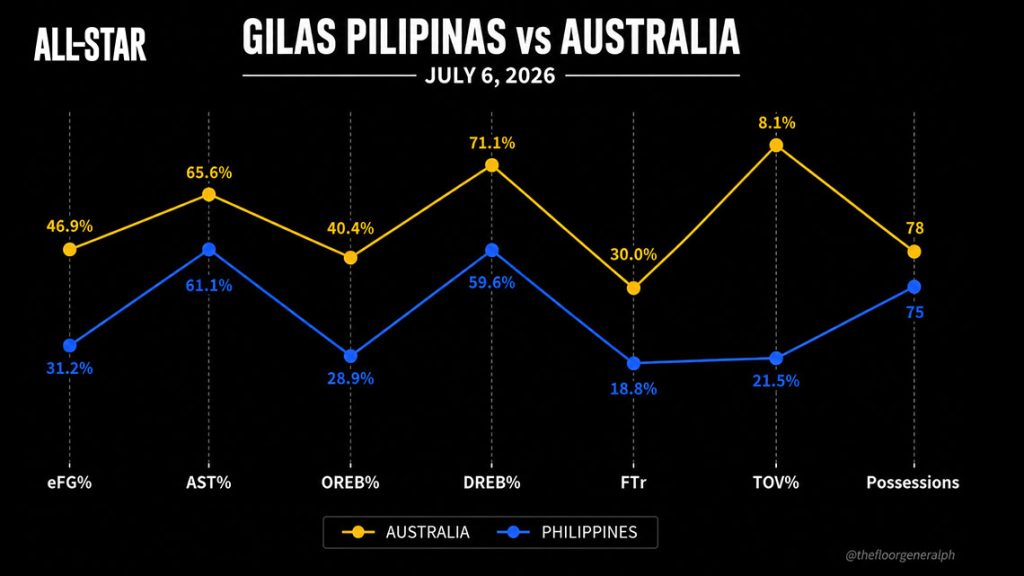
There wasn’t a single major statistical category in which Gilas Pilipinas held an advantage in their second meeting with the Boomers. Simply put, Australia outclassed the national team from start to finish.
The game was effectively decided early. Australia raced to a 33–14 first-quarter lead and never looked back, using its size, pressure, and relentless rebounding to keep Gilas on the back foot throughout the night.
Even without a particularly efficient shooting performance, the Boomers overwhelmed the national team by generating extra possessions through offensive rebounds, forcing turnovers, and consistently creating better looks inside the arc.
More than anything, the game highlighted just how important Justin Brownlee is to Gilas Pilipinas. Even in his relatively quiet outing against New Zealand three days earlier, his impact extended far beyond the box score. His ability to draw defensive attention, create space for teammates, and provide a steady presence on both ends of the floor remains invaluable to the national team.
Without Brownlee, Australia’s defense was able to load up on everyone else. Gilas struggled to generate quality scoring opportunities, and the result was telling—not a single player reached double figures in scoring.
But if there is a bright spot in the Philippines’ dark night, it’s Mike Phillips.
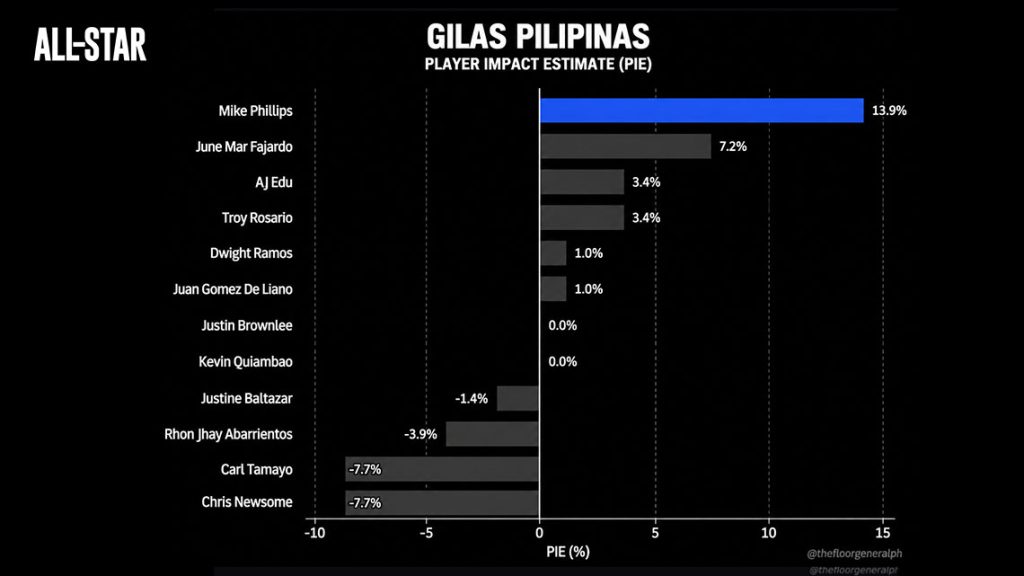
Given the opportunity to start, Mike Phillips wasted little time making his presence felt. Tasked by head coach Tim Cone to bring energy from the opening tip, the former UAAP Finals MVP embraced the role and delivered exactly what was asked of him.
“Coach Tim mentioned to me the other day that I would start. I tried as best to give the energy from the start, and just give my contributions from early on,” Phillips shared in an interview with One Sports.
And give his best he did.
Pulling down a game-high 14 rebounds, Motor Mike posted a team-best 14% PIE, doing everything he could to help Gilas stay competitive against Australia.
In many ways, the Australia game served as both a reality check and a glimpse of the future. The numbers exposed the gap that still separates Gilas Pilipinas from one of the world’s top basketball programs, highlighting the importance of players like Justin Brownlee and the need for a more consistent offensive foundation.
A Deeper Perspective
You might have noticed that despite the emphasis on offensive rebounding and pressure defense creating turnovers—and, in theory, generating extra possessions—the possession gap in the graphs between Gilas Pilipinas and both New Zealand and Australia is not particularly large.
However, there is an important caveat. The possession formula used in the graphs treats an offensive rebound following a missed shot as part of the same possession rather than a new one.
To better understand how possession volume and parity ultimately overwhelmed Gilas Pilipinas, we need to look beyond estimated possessions and examine metrics such as Points Per Possession (PPP) and True Shot Attempts (TSA), which provide a clearer picture of each team’s ability to create and capitalize on scoring opportunities.
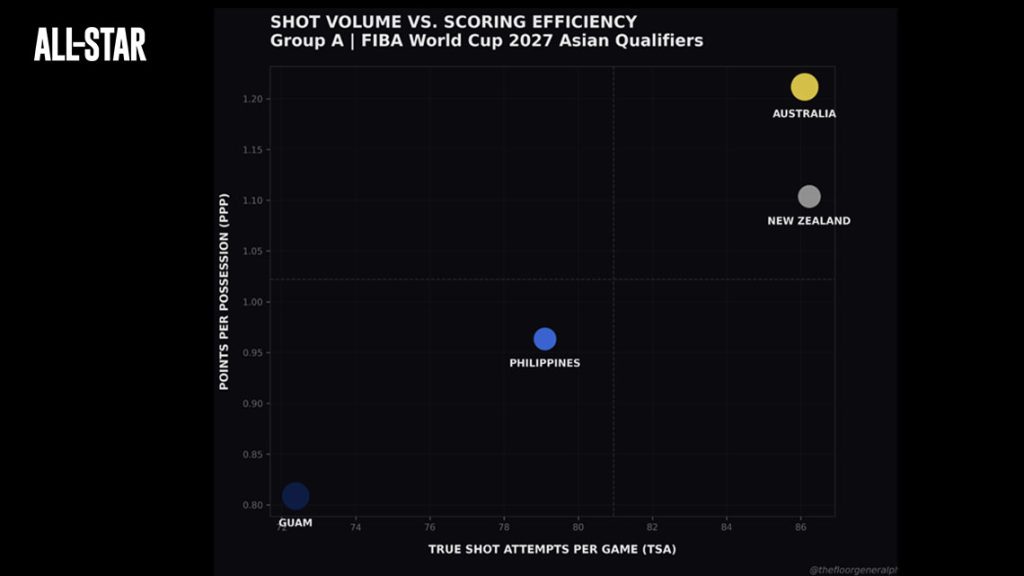
By definition, PPP measures offensive efficiency, showing how many points a team scores for every possession it has, while TSA measures scoring opportunity volume, estimating how many chances a team generated to score through field-goal attempts and trips to the free-throw line.
As the graph shows, both Australia and New Zealand not only generated more scoring opportunities than Gilas—they were also far more efficient in converting them.
If we look strictly at Gilas’ two head-to-head meetings with New Zealand, the Volume Edge slightly favors the Philippines at +0.44. However, the broader picture tells a different story. New Zealand pushed Australia far more competitively and was just as dominant against Guam, resulting in a stronger overall body of work throughout the tournament.
That doesn’t take away from how well Gilas competed against the Tall Blacks. If anything, it shows that the national team is capable of hanging with one of the region’s better sides. But when the entire tournament is taken into account, the gap between Gilas and the top teams in the world remains larger than those two close games might suggest.
Two Losses, One Direction
Taken together, this brutal four-day stretch told two very different stories about where Gilas Pilipinas stands right now. Against New Zealand, the margins came down to execution, composure, and a handful of possessions—proof that the national team is closer than ever to breaking through against Asia-Oceania’s best.
Against Australia, the numbers exposed a wider gap still separating Gilas from one of the world’s true basketball powers, a gap made even more apparent by the absence of both Justin Brownlee and Kai Sotto.
Yet even amid the disappointment, both games pointed to the same underlying takeaway: this Gilas core is building something real. Juan Gomez de Liaño, Kevin Quiambao, and Carl Tamayo’s 31% combined PIE against New Zealand felt like a glimpse of the program’s future arriving in real time, while Mike Phillips’ game-high 14 rebounds and team-best 14% PIE against Australia offered a promising look at the energy, rebounding, and relentless effort the national team can continue to build its identity around.
The losses will sting. But the numbers suggest Gilas Pilipinas isn’t fading—it’s finding its next generation.
For more exclusive basketball stories and updates, click here.