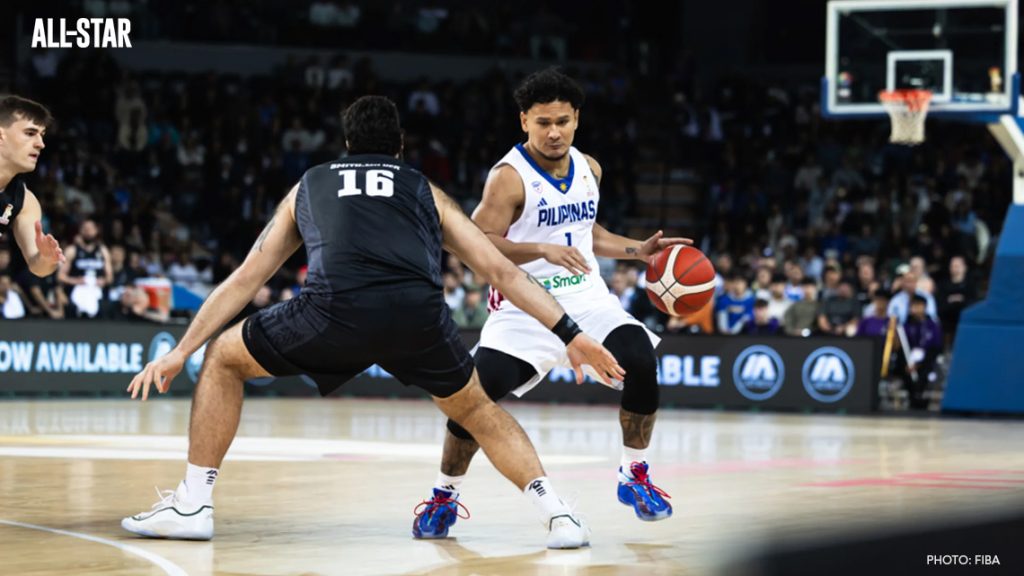
Young Guns Shine as Gilas Pilipinas Pushes NZ to the Brink
There are games that live in the standings, and there are games that linger long after tournaments have ended. For Gilas Pilipinas, Friday’s 106-102 double-overtime loss to New Zealand in Auckland will likely fall into the latter category.
The result leaves the Philippines at 2-2 in Group A entering the final game of the first round against Australia, with every victory carrying over into the second round of the FIBA Basketball World Cup 2027 Asian Qualifiers — a format that makes every possession matter months down the road.
If the stakes made the game significant, the basketball itself elevated it into something more.
Even in Auckland, Gilas never felt like the visiting team. Every Philippine basket was met by a roar that rivaled anything New Zealand produced. It has become one of the unique characteristics of this program: no matter where it plays, the crowd always follows.
That energy was rewarded with one of the most compelling performances of the Tim Cone era.
New Zealand dictated the opening half and eventually built a double-digit advantage, using its physicality to knock Gilas off rhythm in the opening minutes of the third quarter. During one timeout after another bruising sequence, Cone challenged his team with a simple message.
“You got to be stronger out there! You’re getting pushed around!”
The response wasn’t immediate. It was gradual. Then it became relentless.
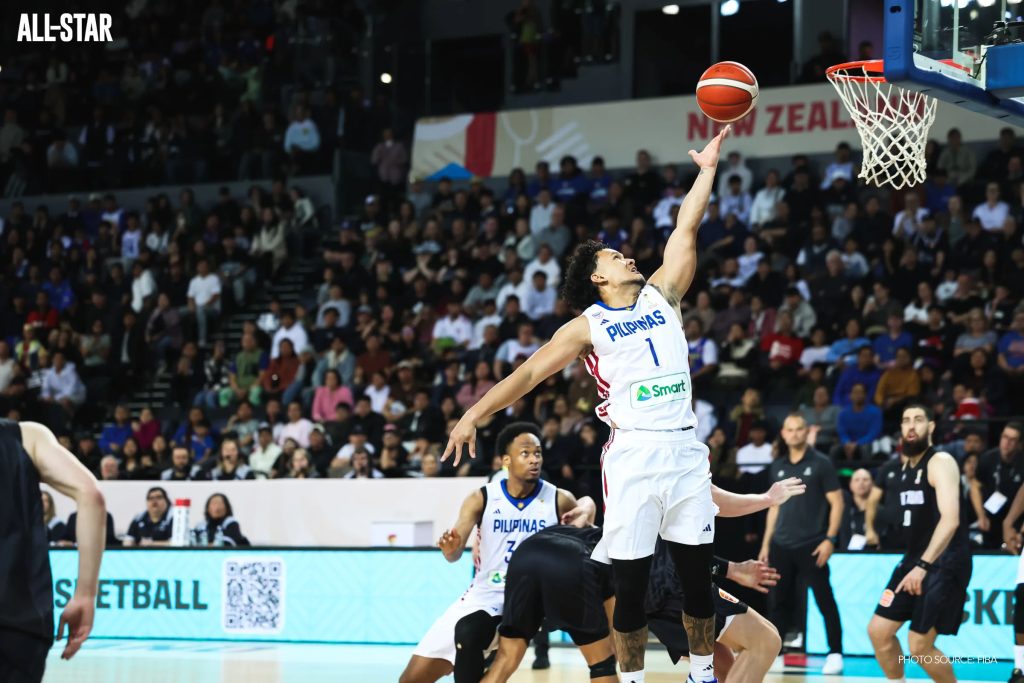
The game marked the arrival of the group that increasingly feels like the next foundation of Philippine basketball.
Kevin Quiambao attacked instead of playing the role of a spectator. Carl Tamayo spaced the floor while punishing closeouts. Juan Gomez de Liaño played with a confidence that never appeared affected by the moment or the opponent.
By the middle of the fourth quarter, something unusual had happened.
Gilas led 70-68 with 6:54 remaining despite Justin Brownlee still sitting on zero points.
New Zealand had spent much of the night loading up on Brownlee with hard doubles, early ball denials, and constant attention whenever he crossed half court. Rather than forcing the issue, the offense flowed elsewhere. Quiambao, Tamayo and Gomez de Liano supplied the scoring, while RJ Abarrientos organized the offense and Mike Phillips changed possessions with nothing more than energy.
Phillips has built a reputation for exactly that.
At one point midway through the second half, his relentless activity visibly irritated Tohi Smith-Milner enough to draw a shove that Phillips simply laughed off. Players who have watched him over the years have seen the same pattern repeatedly: he has an unusual ability to alter the emotional temperature of a game simply by sprinting harder than everyone else. The next step, as Friday again illustrated, is turning that energy into consistent production at the free-throw line.
More broadly, this youthful Gilas group plays with a style that mirrors the generation growing up with it. There is pace. There is swagger. There is a willingness to attack rather than wait.
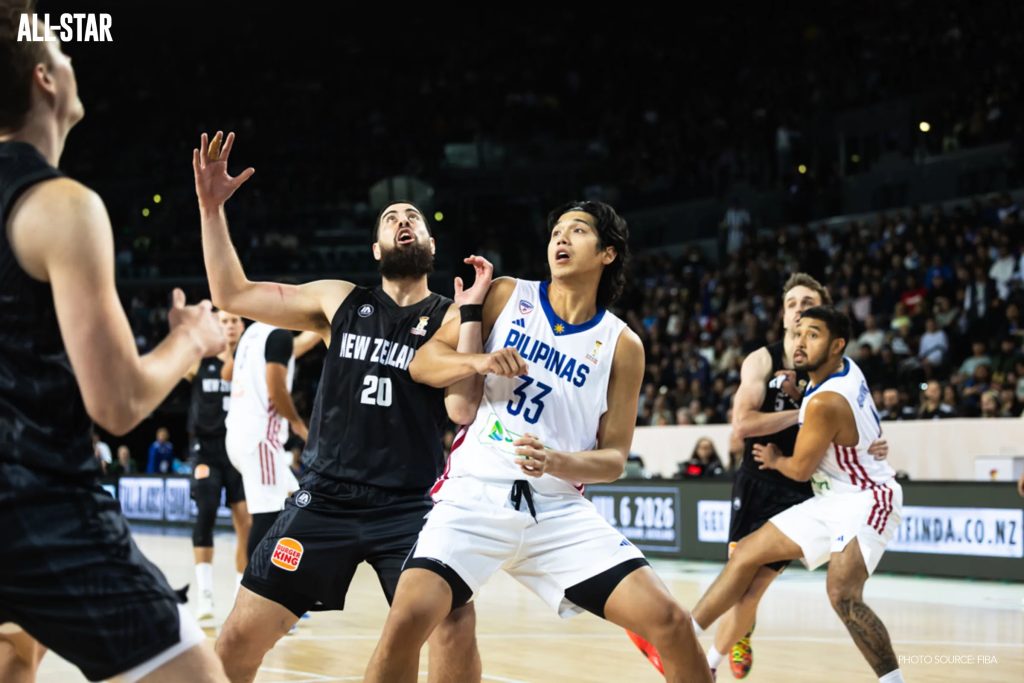
That identity nearly produced one of the program’s biggest road victories in recent memory.
After Quiambao and Dwight Ramos connected on consecutive three-pointers—including Ramos’ fortunate bounce that hung on the rim before dropping—the Philippines suddenly owned a 77-70 lead with just over four minutes remaining.
The response from New Zealand revealed why the Tall Blacks remain one of Asia-Oceania’s most disciplined teams.
Reuben Te Rangi immediately answered with a corner three against a sleeping Gilas transition defense. Moments later, an Abarrientos turnover became a Carlin Davison dunk. After consecutive misses by Quiambao and Gomez de Liano, an unsportsmanlike foul sent New Zealand to the line, and within minutes the seven-point cushion had disappeared.
That sequence captured the game’s defining tension. Every time Gilas created separation, New Zealand found a way to erase it without panic.
Tai Webster answered Quiambao’s jumper with consecutive paint finishes. Shea Ili calmly converted two pressure free throws. Brownlee committed a late turnover after an isolation drive.
Still, Gilas never stopped responding.
Trailing by three with 11 seconds left, Gomez de Liano walked the ball up the floor, stepped into rhythm and buried an open three to tie the game at 83.
It was a moment where a potential superstar rises to the occasion.
New Zealand missed twice in the closing seconds, a tip was made after the horn, and the game drifted into overtime.
That shot became the latest addition to Gomez de Liano’s growing collection of big moments.
His final line — 23 points, six rebounds and four assists on 9-of-15 shooting — only partially captured his impact. More revealing was his willingness to continue demanding the basketball after every mistake. There were turnovers. There were learning moments. None altered his posture.
If Gilas has spent years searching for another perimeter player comfortable living inside high-pressure possessions, Gomez de Liaño offered another compelling argument Friday night.
Quiambao was equally influential.
His 23 points came on 9-of-16 shooting, but his fingerprints extended well beyond scoring. He repeatedly attacked closeouts, defended multiple positions and hit several momentum-changing baskets that prevented New Zealand from pulling away.
Tamayo quietly added 17 points on 7-of-12 shooting while knocking down three of his four attempts from beyond the arc, continuing a stretch in which his offensive versatility has become increasingly important to Cone’s system.
Together, the trio combined for 63 of the Philippines’ 102 points.
For long stretches, they carried the offense. Overtime, however, became a battle of details.
The Philippines actually shot better than New Zealand across virtually every category, finishing at 47.5 percent from the field while converting nearly 58 percent inside the arc. It also produced 27 assists on 38 made baskets, evidence of an offense creating quality opportunities rather than surviving on isolation. Yet New Zealand consistently won the margins.
The Tall Blacks grabbed 19 offensive rebounds, repeatedly extending possessions that appeared finished. They earned 35 free-throw attempts compared to the Philippines’ 22. Gilas committed 20 turnovers. New Zealand committed 16.
Those hidden possessions accumulated.
A Brownlee offensive foul in the second overtime led directly to a Sam Mennenga dunk. Another Mennenga offensive rebound with 14 seconds left produced the go-ahead basket. Gomez de Liano’s late turnover prevented the Philippines from attempting a tying shot in the closing seconds.
The final score belonged to New Zealand.
The broader picture felt less straightforward.
For years, Philippine basketball has relied heavily on veterans and naturalized stars to shoulder its biggest moments. Friday suggested something different may be emerging. Brownlee’s gravity remained indispensable even during a five-point night, but much of Gilas’ offensive creation came from players who could define the next decade of the program.
The standings will record this as another New Zealand victory.
The game itself offered a longer conversation. It showcased a Philippine team that matched one of the region’s most established programs possession for possession on the road, recovered from a deficit instead of wilting away, and leaned on a new generation that looked increasingly comfortable carrying the weight of the jersey.
That may not have been enough to leave Auckland with a win.
It was enough to leave with something worth watching.