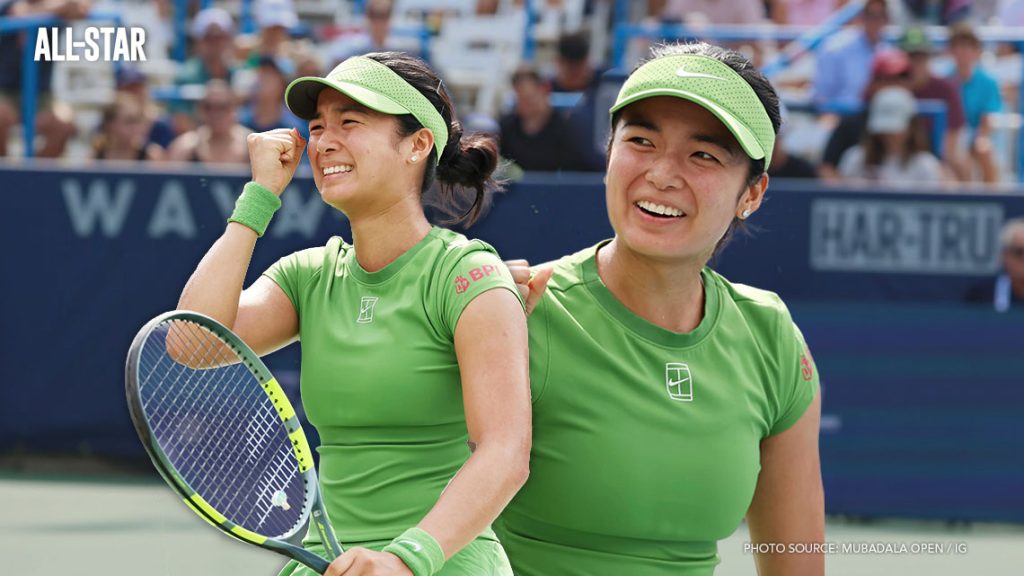
Alex Eala Turns Possibility Into Proof in Washington
Alex Eala had already shown that she could trouble the best players in women’s tennis. In Washington, she proved that she could go through them and leave with the trophy.
Eala defeated world No. 3 Jessica Pegula, 4-6, 6-4, 6-0, in the final of the Mubadala DC Open, becoming the first Filipino to win a WTA Tour singles title and the first to claim a championship at the WTA 500 level.
Eala had previously won WTA 125 tournaments in Guadalajara and Birmingham, important steps on the professional ladder but one tier below the main tour. Washington required her to survive a field filled with established champions, top-10 players, and opponents accustomed to the closing rounds of major events.
For a player whose ascent has often been described through historic firsts, this one feels different. It is not only about arriving somewhere no Filipino tennis player had been. It is about finishing the job.
She did not take a gentle road.
Eala opened by recovering from a set down against Olympic champion Zheng Qinwen. She eliminated defending Washington champion Leylah Fernandez after trailing 5-1 in the second set. She then defeated top-10 player Elina Svitolina before controlling her semifinal against four-time major champion Naomi Osaka, 6-4, 6-2.
Pegula, the tournament’s top seed and one of the most reliable hard-court players of her generation, represented the final examination. The match began Sunday, with Pegula taking the opening set 6-4 and Eala leading 2-1 in the second when rain forced play to be suspended. Eala returned the following day needing to solve both an elite opponent and the strange emotional interruption of an unfinished final.
By the time the final set began bending entirely toward Eala, Washington was nowhere close to being neutral ground.
Every fearless return and sharply struck winner drew another roar from the Filipinos in the stands, their voices carrying across oceans to homes where families watched through the Philippine hatinggabi with anticipation, tears, and a love that had followed her around the world.
Pegula, who is typically so accomplished and so difficult to unsettle, was unraveling before a young woman playing with an almost startling combination of clarity and abandon. Part of that force came from Eala’s left-handed precision and refusal to retreat; part of it came from the years spent far from home, the championship points that escaped her at Eastbourne, and every lesson absorbed on the long road back to another final.
Only Alex knows what she felt as the games disappeared into a 6–0 set, but perhaps she could sense everything converging: the sacrifice behind her, a nation rising with her, and the future suddenly opening in front of her. Tennis promises nothing, even to its brightest talents. Yet as Eala stood one point from history, it was difficult to believe we were watching a destination. It felt more like the opening line of everything still to come.
Her victory became her seventh over a top-10 opponent in 2026. It also completed an unusual sweep: over the course of the season, Eala has beaten all three women’s singles medalists from the Paris Olympics: Zheng, Donna Vekic and Iga Swiatek.
A year ago, Eala’s run to the Miami Open semifinals could still be viewed as a spectacular fortnight produced by a fearless young wildcard. She has since reached the fourth round of Wimbledon, made deep runs on grass and hard courts, collected victories against several of the tour’s leading players, and now won five consecutive matches in a WTA 500 field.
Washington makes the word “upset” less useful when discussing her. Her victories over prominent opponents may still be surprises according to ranking, but they no longer feel accidental.
Eala entered the tournament ranked No. 28 and is expected to move into the top 25. It improves her chances of being seeded at major tournaments and reduces the likelihood of meeting the highest-ranked players in the earliest rounds. It also places her within view of the WTA Finals race, although considerable work remains before that becomes more than an outside possibility.
Toronto, Cincinnati, and the US Open will now test how well she manages success. The rain-delayed final shortened her recovery window before another WTA 1000 event, and the physical cost of a championship week does not disappear because the player is 21 years old. Choosing when to compete, when to recover, and when to protect her body will become as consequential as anything she does with a racket.
Eala has generally spoken about that work without pretending she has already mastered it. After reaching the Washington final, she said, “I’m really happy with how I performed and how I’ve conducted myself on court against this caliber of players.”
That self-assessment is more useful than declaring her the next inevitable major champion. Tennis offers no such guarantees. The women’s tour is too deep, careers are too fragile, and progress is rarely as smooth as a rankings graph makes it appear.
What Washington provides is evidence that Eala’s ambitions are no longer supported by potential alone.
For the Philippines, the championship carries a different weight.
Elite tennis remains an improbable pursuit for most Filipino children. It demands expensive coaching, international travel, suitable courts, and years of competition far from home. Eala’s success does not remove those barriers or substitute for a serious national development system. Inspiration without infrastructure can only go so far.
What she has done is make the pathway visible.
A Philippine flag now appears regularly in the closing rounds of internationally significant tournaments. Filipino communities that once watched the tour without a player of their own have filled seats in Miami, New York, Dubai, London, and Washington. Some arrive knowing tennis intimately. Others are learning its scoring, etiquette, and rhythms because Eala has given them a reason to care.
Before leaving the Philippines for the North American swing, she wrote that she had never been prouder to represent home. In Washington, that representation reached a new stage. She was not a ceremonial presence or a pleasant story attached to the draw. She was the champion.
The title belongs to Eala. She earned it point by point, through the labor of a largely individual sport.
But the possibility it enlarges belongs to many more people. Somewhere in the Philippines, a child can now imagine winning on the WTA Tour without first having to imagine being the first.
Alex Eala has already taken care of that part.